

Key Takeaways
- Free cloud storage tiers are real and useful, but they come with meaningful limitations worth understanding.
- Storage caps, data practices, and limited file-recovery windows are common trade-offs on no-cost plans.
- Evaluating what you store — and how critical it is — helps determine whether a free tier is genuinely sufficient.
- Upgrading to a paid plan may be worthwhile if free storage becomes a reliability bottleneck.
Zero upfront or recurring cost
Free tiers require no payment information and no commitment, making them accessible to anyone wanting basic file sync or backup without financial risk.
Accessible across multiple devices
Files stored on a free plan are typically reachable from any device with the app or a browser, which is the core convenience cloud storage is designed to deliver.
Sufficient for light, everyday use
For users syncing a small number of documents or sharing occasional photos, 5–15 GB of free storage can meet real needs without any limitation becoming apparent.
Low-friction way to evaluate a service
A free tier lets you test an app's interface, sync reliability, and feature set before deciding whether a paid plan is worth the cost.
Storage caps fill quickly with modern files
High-resolution photos, videos, and even email attachments accumulate fast. A 15 GB limit can feel spacious at first but become a bottleneck within months of regular use.
Short or absent file version history
Free plans often limit deleted file recovery or version rollback to 30 days or fewer, leaving users exposed if a problem isn't caught quickly.
Data may inform advertising or analytics
Some providers use anonymized usage patterns or metadata to fund free services. Reviewing each provider's privacy policy before uploading sensitive documents is a practical precaution.
No guaranteed uptime or support priority
Free users typically lack formal service-level agreements and may wait longer for support responses compared to paying subscribers during service disruptions.
Upgrade pressure through friction
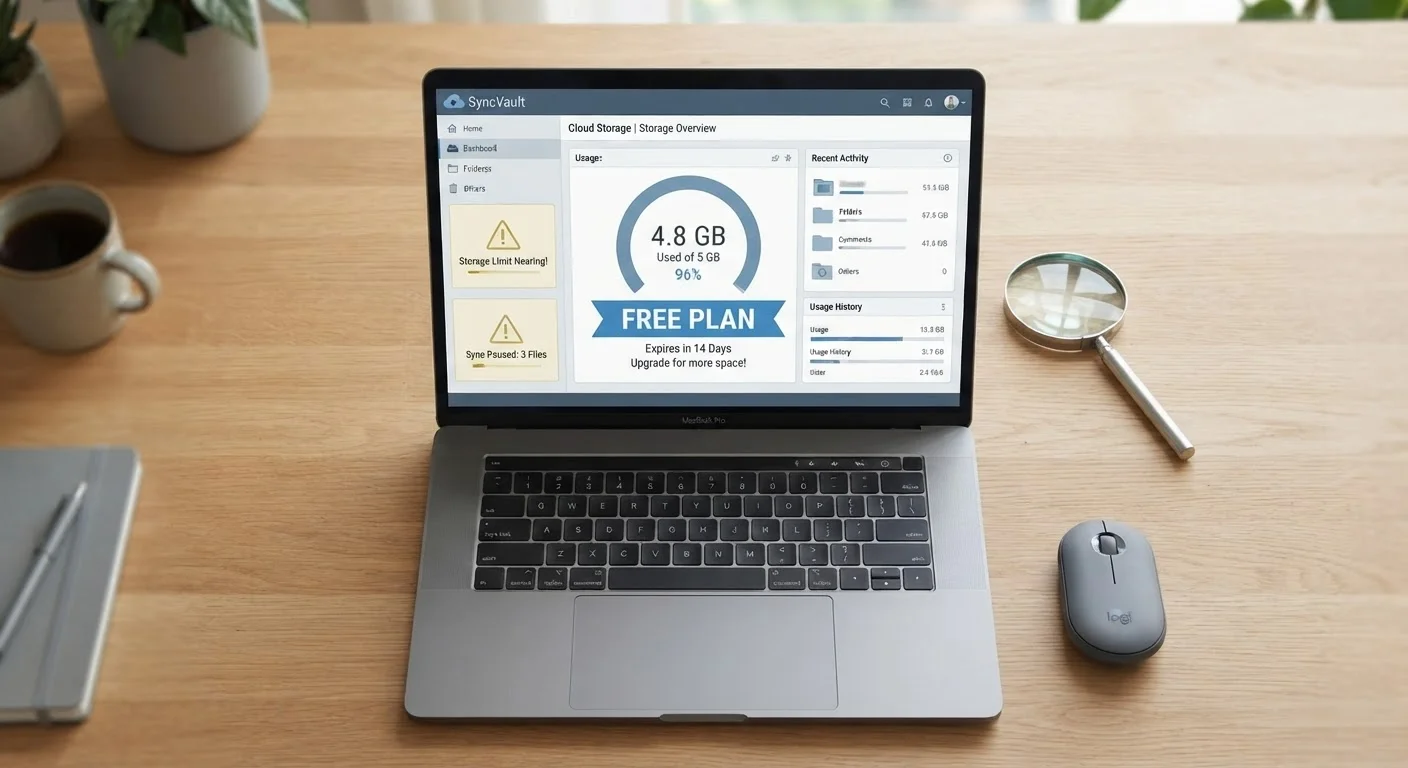
Storage warnings, feature locks, and prompt notifications are deliberately designed to surface regularly once a free tier nears its limits, nudging users toward paid plans.
Our Verdict
Free cloud storage tiers provide genuine value for light, non-sensitive use — syncing a handful of documents or sharing occasional photos costs nothing and works reliably. However, the trade-offs compound quickly: tight storage caps, shorter file recovery windows, and data practices tied to advertising models deserve careful consideration before you rely on a free tier for anything important. For most everyday users, a free plan is a reasonable starting point, not a permanent solution.
Best suited for users with modest storage needs who store non-sensitive files and maintain local backups as a safety net.
What You're Actually Getting With a Free Plan
Free cloud storage tiers are genuinely useful — they let you sync documents, back up photos, and access files across devices without spending a dollar. Most major providers offer somewhere between 5 GB and 15 GB at no cost, which is enough for text files, spreadsheets, and a modest photo library. If your needs are light, a free plan can serve you indefinitely.
That said, "free" describes the price tag, not the full picture. Providers offering no-cost storage still run businesses, and the mechanics of how they do that shape your experience in ways that aren't always obvious at sign-up. Understanding the actual terms — not just the storage number — is how you avoid surprises down the line.
For a broader foundation on how cloud storage works before evaluating any plan, the comprehensive beginner's guide to cloud storage is a useful starting point.
Zero upfront or recurring cost
Free tiers require no payment information and no commitment, making them accessible to anyone wanting basic file sync or backup without financial risk.
Accessible across multiple devices
Files stored on a free plan are typically reachable from any device with the app or a browser, which is the core convenience cloud storage is designed to deliver.
Sufficient for light, everyday use
For users syncing a small number of documents or sharing occasional photos, 5–15 GB of free storage can meet real needs without any limitation becoming apparent.
Low-friction way to evaluate a service
A free tier lets you test an app's interface, sync reliability, and feature set before deciding whether a paid plan is worth the cost.
The Real Trade-Offs Worth Knowing
The limitations of free tiers cluster around four areas: storage capacity, file versioning, data practices, and reliability guarantees.
Storage caps fill up faster than expected. A single uncompressed photo from a modern smartphone can exceed 10 MB. A 15 GB free allotment — which sounds large — holds roughly 1,500 such photos. Once full, new uploads are blocked until you delete files or upgrade. Some providers automatically compress uploads to stretch capacity, but that affects image quality.
File recovery windows are shorter. Many free plans limit version history — the ability to recover an earlier version of a file or restore something accidentally deleted — to 30 days or less. Paid tiers often extend this to 180 days or a year. If you notice a problem late, a free plan may not save you.
Data practices vary widely. Some providers use anonymized usage data for advertising or product improvement. This doesn't necessarily mean your files are read, but it's worth reviewing the privacy policy before uploading sensitive documents. The cloud storage myths fact-check addresses common misconceptions about what providers can and cannot see.
No uptime or support guarantees. Free users typically receive lower-priority customer support and no service-level agreements. If something goes wrong, resolution timelines are less predictable than for paying subscribers.
Storage caps fill quickly with modern files
High-resolution photos, videos, and even email attachments accumulate fast. A 15 GB limit can feel spacious at first but become a bottleneck within months of regular use.
Short or absent file version history
Free plans often limit deleted file recovery or version rollback to 30 days or fewer, leaving users exposed if a problem isn't caught quickly.
Data may inform advertising or analytics
Some providers use anonymized usage patterns or metadata to fund free services. Reviewing each provider's privacy policy before uploading sensitive documents is a practical precaution.
No guaranteed uptime or support priority
Free users typically lack formal service-level agreements and may wait longer for support responses compared to paying subscribers during service disruptions.
Upgrade pressure through friction
Storage warnings, feature locks, and prompt notifications are deliberately designed to surface regularly once a free tier nears its limits, nudging users toward paid plans.
How Free Cloud Storage Compares to Keeping Files Local
One underappreciated alternative is simply keeping more files on your own device or an external drive. Local storage has no subscription cost, no data-practice concerns, and no dependency on internet connectivity. But it also means no automatic off-site backup — a hard drive failure or theft could mean permanent loss.
The practical answer for most people isn't either-or. A free cloud tier works well as a lightweight sync and access layer, while local storage handles bulk archiving. Understanding the real trade-offs between local and cloud storage can help you decide how to split the workload based on your actual habits.
Check What Happens When You Downgrade
If you ever upgrade a free plan and later cancel, your files may not simply return to free-tier access. Some providers queue files for deletion or make them inaccessible if your storage exceeds the free limit after downgrading. Before upgrading, read the provider's downgrade policy so you understand exactly what happens to your data if you later decide to stop paying.
One risk that catches many users off guard: what happens to your files if you upgrade, then cancel. Some providers move files to a read-only or queued-for-deletion state when you downgrade back to a free tier. See why files disappear after cancelling a cloud subscription for specifics on how deletion policies work.
When to Consider Upgrading — and When Not To
A paid plan makes sense when free storage is consistently full, when you store files you can't afford to lose without version history, or when you're sharing access with family members and need collaborative features. Cloud storage for families is worth reading if household sharing is part of your use case.
If your storage use is stable and you maintain a local backup habit, a free tier may be entirely adequate. The goal isn't to upgrade by default — it's to make a deliberate decision rather than drift into dependency on a plan whose limits you haven't examined. What you're actually getting when you upgrade app tiers provides a useful framework for evaluating that decision across any subscription service.
5–15 GB
Typical free storage tier size
Most major cloud storage providers offer between 5 GB and 15 GB at no cost, though exact amounts vary by platform and may change over time.
30 days
Common free-tier file recovery window
Many free cloud storage plans limit deleted file or version recovery to approximately 30 days, compared to 180 days or more on some paid tiers.