
Standalone vs Non-Standalone 5G: Why Network Architecture Changes Your Experience

Key Takeaways
- Most 5G networks deployed today still use Non-Standalone architecture, anchored to 4G LTE.
- Standalone 5G unlocks features like network slicing and significantly lower latency that NSA cannot deliver.
- Your phone may show a 5G icon regardless of whether the underlying network is SA or NSA.
- SA rollout is ongoing — coverage varies widely by carrier and region.
- Understanding architecture helps explain why some 5G connections feel faster or more responsive than others.
Standalone vs Non-Standalone 5G
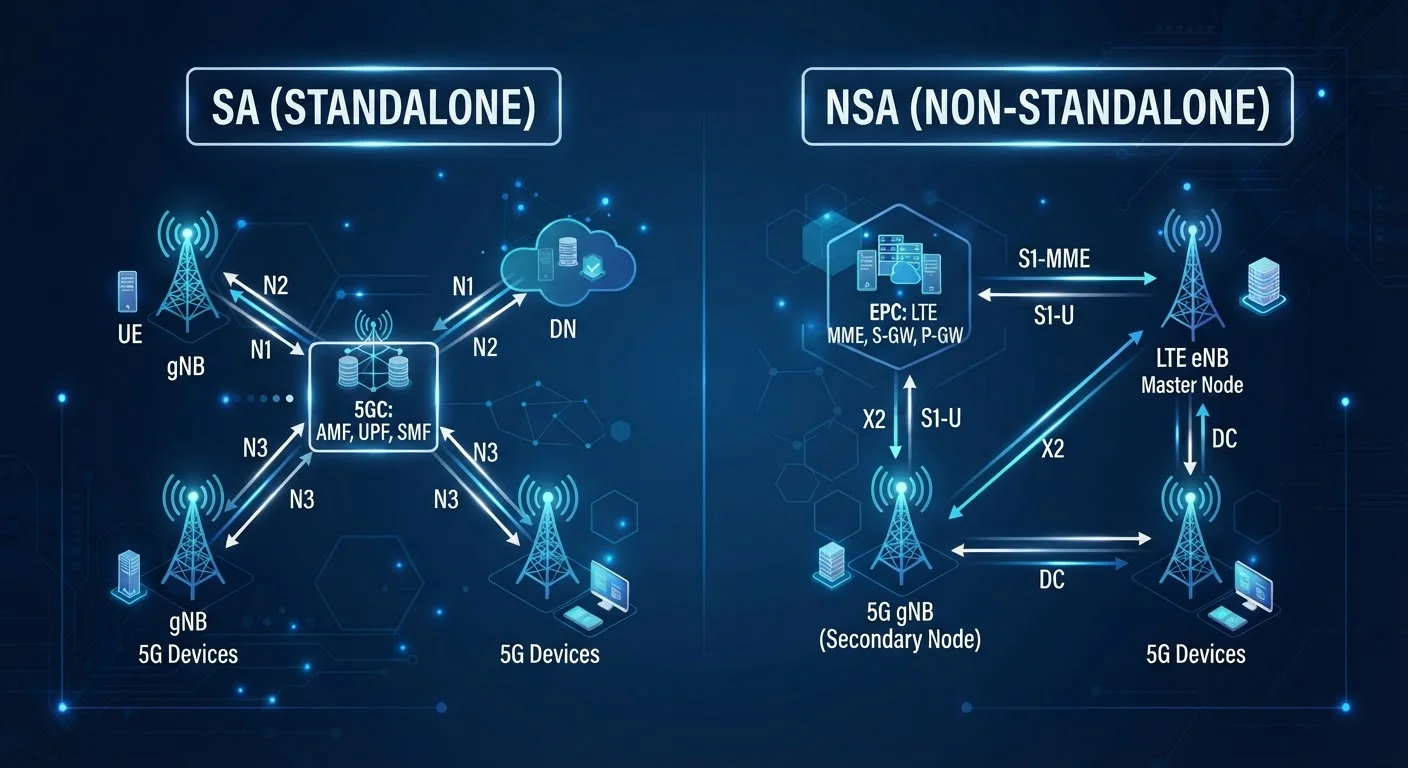
Non-Standalone (NSA) 5G uses an existing 4G LTE core network as its backbone, adding 5G radio access on top. Standalone (SA) 5G operates on a completely new, purpose-built 5G core network with no reliance on 4G infrastructure. The architecture a carrier deploys determines which advanced 5G capabilities — like ultra-low latency and network slicing — are actually available to consumers.
The distinction maps to 3GPP Release specifications: NSA follows Option 3 (EN-DC dual connectivity), while SA follows Option 2, with a full 5G Core (5GC) replacing the Evolved Packet Core (EPC).
The Hidden Architecture Behind Your 5G Signal
When your phone displays a 5G indicator, it tells you almost nothing about what kind of 5G you're actually using. The more consequential question — one that directly affects your experience — is whether your carrier's network is built on Standalone (SA) or Non-Standalone (NSA) architecture.
NSA 5G was designed as a transitional approach. Carriers attach 5G radio equipment to cities and towers but route control signaling through their existing 4G LTE core — the same network management infrastructure that has handled calls and data for years. This lets carriers roll out 5G coverage quickly without rebuilding from scratch. The tradeoff: the network's intelligence and responsiveness are still governed by 4G-era systems.
SA 5G takes a fundamentally different approach. Both the radio access layer and the core network are fully 5G. That means the entire data path — from your device to the internet — runs through 5G-native systems, enabling capabilities the 4G core simply wasn't designed to support. For a broader look at how 5G works at a foundational level, see our full 5G explainer.
The 5G Icon Doesn't Tell the Whole Story
Both SA and NSA networks display the same 5G indicator on your phone's status bar. There is currently no universal visual indicator that distinguishes between the two architectures in consumer device interfaces. The only way to know which type your carrier is using is to consult carrier documentation or independent network analysis tools.
What NSA Architecture Actually Limits
The most direct consequence of NSA architecture is latency. In an NSA network, your device maintains a dual connection: 5G handles the heavy data transfer, but 4G LTE manages the control plane — the signaling layer that establishes connections, routes requests, and coordinates the network session. Because that control plane runs over 4G, round-trip response times are bounded by 4G performance, typically in the 20–30 millisecond range rather than the sub-10ms that Standalone 5G targets.
NSA also cannot support network slicing — a feature that allows carriers to carve out dedicated, guaranteed-performance portions of the network for specific uses, such as industrial IoT or emergency services. Slicing requires a 5G Core that can dynamically manage those partitions. An LTE-anchored core has no such capability.
For most consumers doing everyday tasks — streaming video, social media, navigation — the practical difference between NSA and SA may be marginal today. But for latency-sensitive applications like cloud gaming or augmented reality, SA architecture matters more. A comparison of 4G LTE and 5G in daily use shows where these distinctions become tangible.
Check Your Device's 5G Mode Settings
Some Android phones allow you to view or switch between SA and NSA 5G modes in the network settings menu. If your carrier supports SA and your device is compatible, ensuring SA mode is enabled can make a difference in latency-sensitive scenarios. iOS devices manage this automatically based on carrier profiles.
What Standalone 5G Unlocks
A full SA deployment changes what a 5G network can do at every layer. With a native 5G Core in place, carriers can enable features defined in the 3GPP standards that NSA simply cannot access:
- Lower latency: End-to-end 5G signaling reduces the round-trip time that affects real-time applications.
- Network slicing: Operators can allocate dedicated network resources to specific service types or customer segments.
- Edge computing integration: SA architecture supports closer coordination with mobile edge compute nodes, reducing data travel distances.
- More efficient device power management: 5G Core protocols include improved mechanisms for how devices connect and idle, which can influence battery efficiency over time.
It's also worth noting that SA and NSA are not the only variables in your 5G experience. The radio frequency your carrier uses — Sub-6 GHz or mmWave — has its own performance implications. Sub-6 GHz and mmWave behave very differently, and the two dimensions interact.
<10 ms
Target latency for Standalone 5G
The 3GPP standard targets sub-10ms latency for SA 5G, compared to the 20–30ms typical of 4G-anchored NSA deployments.
20–30 ms
Typical NSA 5G latency range
Because NSA 5G uses the 4G LTE core for control plane signaling, round-trip latency remains comparable to standard LTE performance.
Option 3 vs Option 2
3GPP deployment options
NSA follows 3GPP Option 3 (EN-DC), while SA follows Option 2 — the architecture defined for a fully independent 5G Core network.
What This Means When Choosing a Plan or Device
Architecture isn't something you can see on a carrier's marketing page, but it does influence whether the 5G features promoted today will actually reach you. A few practical considerations:
Check device compatibility: Confirm your phone supports SA mode. This is listed in the device specification sheet under supported 5G network modes or bands. NSA-only devices won't benefit from SA upgrades even after a carrier deploys them.
Ask about SA rollout: Some US carriers have begun SA deployments in select markets. Coverage is not uniform, and SA availability in your specific area is the key variable — not just whether your carrier has announced SA anywhere.
Set realistic expectations: An NSA network with strong 5G radio coverage and solid mid-band spectrum will often outperform a sparse SA deployment in practice. Architecture matters most when everything else is equal. For a full checklist before committing to a 5G plan, review what to know before switching to 5G.
Understanding where today's 5G sits in the longer arc of mobile network evolution also helps calibrate expectations — tracing mobile generations from 1G to 5G shows how each infrastructure shift took years to deliver on its promises.