

| 1G launched | ~1983 (US AMPS network) |
| 2G introduced | 1991 (GSM standard) |
| 3G peak speeds | Up to ~42 Mbps (HSPA+) |
| 4G LTE typical speeds | 20–50 Mbps download (real-world) |
| 5G peak theoretical speed | Up to 20 Gbps (3GPP Release 15 specification) |
| 5G target latency | As low as 1ms (ideal conditions) |
The Short Version: What a "Generation" Actually Means
In mobile networking, a generation is a set of agreed technical standards that define how phones communicate with cell towers — covering speed, capacity, and the types of data a network can carry. Each new generation isn't just a speed bump; it typically introduces a fundamentally different radio technology and unlocks new categories of use. Understanding this history helps make sense of what 5G actually promises — and what it doesn't.
| 1G launched | ~1983 (US AMPS network) |
| 2G introduced | 1991 (GSM standard) |
| 3G peak speeds | Up to ~42 Mbps (HSPA+) |
| 4G LTE typical speeds | 20–50 Mbps download (real-world) |
| 5G peak theoretical speed | Up to 20 Gbps (3GPP Release 15 specification) |
| 5G target latency | As low as 1ms (ideal conditions) |
For a deeper look at how current connectivity standards compare side by side, see our plain-language guide to 5G, Wi-Fi 6, and Bluetooth 5.
1G Through 4G: The Building Blocks
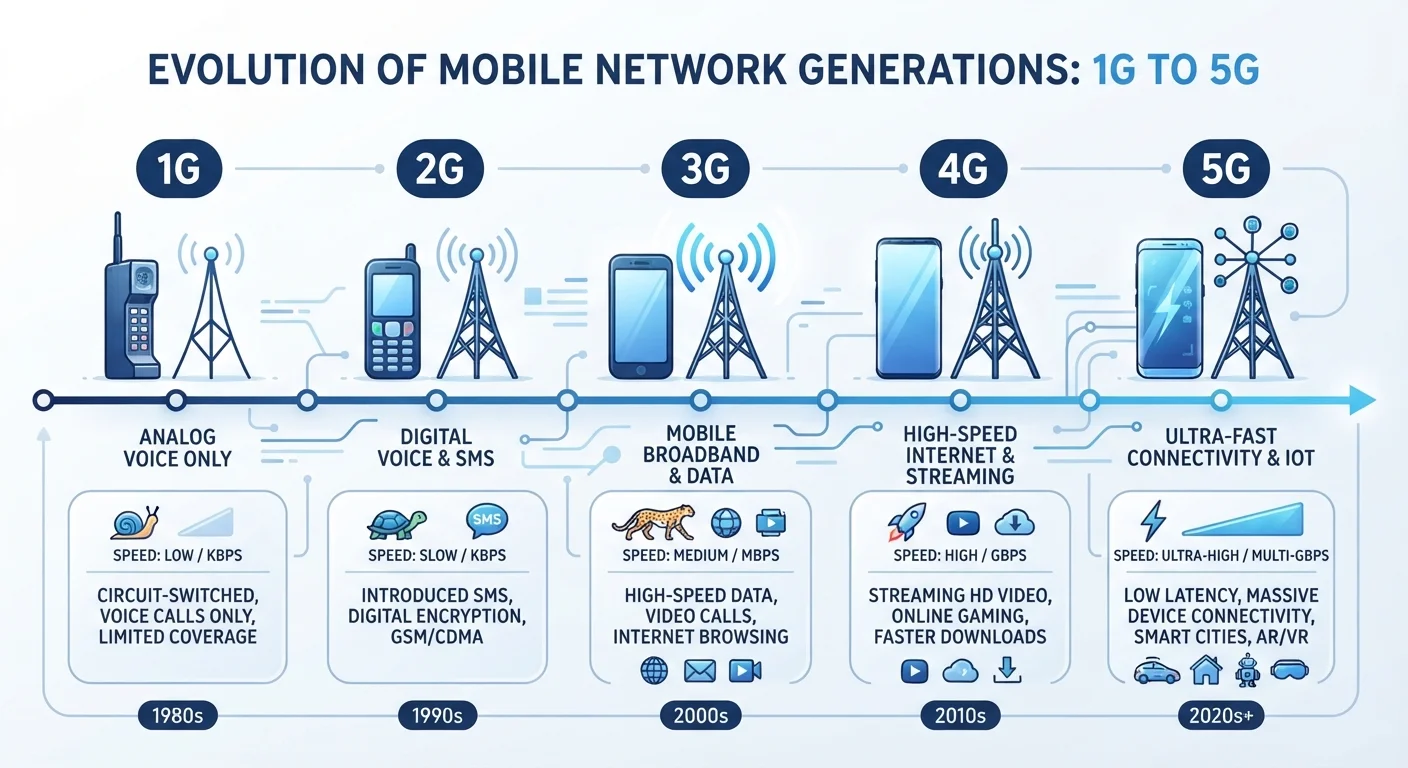
1G — Analogue Voice (1980s)
The first commercial cellular networks, launched in the early 1980s, carried analogue voice signals. Calls were often scratchy and unencrypted, meaning conversations could be intercepted with basic radio equipment. Data transmission was not part of the design. The US system known as AMPS (Advanced Mobile Phone System) was typical of this era.
2G — Digital Voice and SMS (1990s)
The shift to digital in the 1990s transformed mobile communication. 2G networks — primarily GSM in most of the world — encrypted calls, improved voice quality, and introduced text messaging (SMS). A later enhancement called GPRS added limited data, enough to support early mobile email at speeds measured in kilobits per second.
3G — Mobile Internet (2000s)
3G brought genuinely usable mobile internet for the first time. Speeds in the hundreds of kilobits per second — later reaching a few megabits with HSPA upgrades — were fast enough for web browsing, app downloads, and early video streaming. The smartphone era was built on 3G infrastructure.
4G LTE — Broadband in Your Pocket (2010s)
LTE moved mobile data into genuine broadband territory. Typical real-world download speeds of 20–50 Mbps enabled HD video streaming, video calls, and cloud-based apps as everyday experiences. 4G also dramatically reduced latency — the delay between sending a request and receiving a response — from around 100ms on 3G to roughly 30–50ms on LTE. For a practical comparison of 4G and its successor, see how 4G LTE and 5G differ in daily use.
Generation (G)
A defined set of mobile network standards agreed upon by international bodies. Each generation introduces new radio technology and capabilities rather than simply increasing speed.
Latency
The time delay between sending a data request and receiving a response, measured in milliseconds (ms). Lower latency means snappier app interactions and better real-time performance.
Spectrum band
A range of radio frequencies allocated for wireless communication. Different bands offer different trade-offs between signal range and data capacity.
mmWave
Millimetre wave spectrum above 24 GHz used in some 5G deployments. It supports very high speeds over short distances but is easily blocked by buildings and other obstacles.
LTE
Long-Term Evolution, the dominant 4G standard. LTE brought mobile broadband speeds and low enough latency to support HD streaming and video calls as everyday activities.
3GPP
The 3rd Generation Partnership Project, an international standards body that defines technical specifications for mobile networks from 3G onward, including 4G LTE and 5G.
5G — What Changes and What Doesn't
5G, standardized under 3GPP's Release 15 and later releases, operates across three spectrum bands that involve real trade-offs:
- Low-band (sub-1 GHz): Wide coverage, comparable speeds to late 4G — the backbone of broad 5G availability.
- Mid-band (1–6 GHz): Balances coverage and speed; typically delivers 100–400 Mbps in practice.
- mmWave (above 24 GHz): Extremely fast but very short range and blocked by walls and foliage — limited to dense urban deployments.
~1ms
Target latency on 5G (ideal conditions)
3GPP specifications set a 1ms latency target for 5G under optimal network conditions — far below the 30–50ms typical on 4G LTE.
100×
More connected devices per sq km vs 4G
5G is designed to support up to 1 million connected devices per square kilometer, enabling dense IoT deployments alongside consumer phones.
20 Gbps
Peak theoretical 5G download speed
This figure reflects 3GPP specification ceilings; real-world consumer speeds are substantially lower depending on band, location, and network load.
The headline improvements 5G targets are peak speeds up to 20 Gbps, latency as low as 1ms under ideal conditions, and the ability to connect vastly more devices per square kilometer. In everyday consumer use, the gains are meaningful but more modest than marketing suggests. To set accurate expectations, read our full breakdown of what 5G actually does and doesn't do.
If you're weighing whether to upgrade your plan, our pre-switch guide covers coverage checks, compatible devices, and plan structures. For foundational smartphone concepts, the Smartphone Basics hub is a useful starting point.
Coverage Still Varies Widely Across the US
5G availability ranges from dense city mmWave deployments to rural areas where only low-band 5G — with speeds close to advanced 4G — is accessible. Checking a carrier's publicly available coverage map for your specific address before making any plan decisions is a practical first step. Network experience can differ significantly even within the same city.