

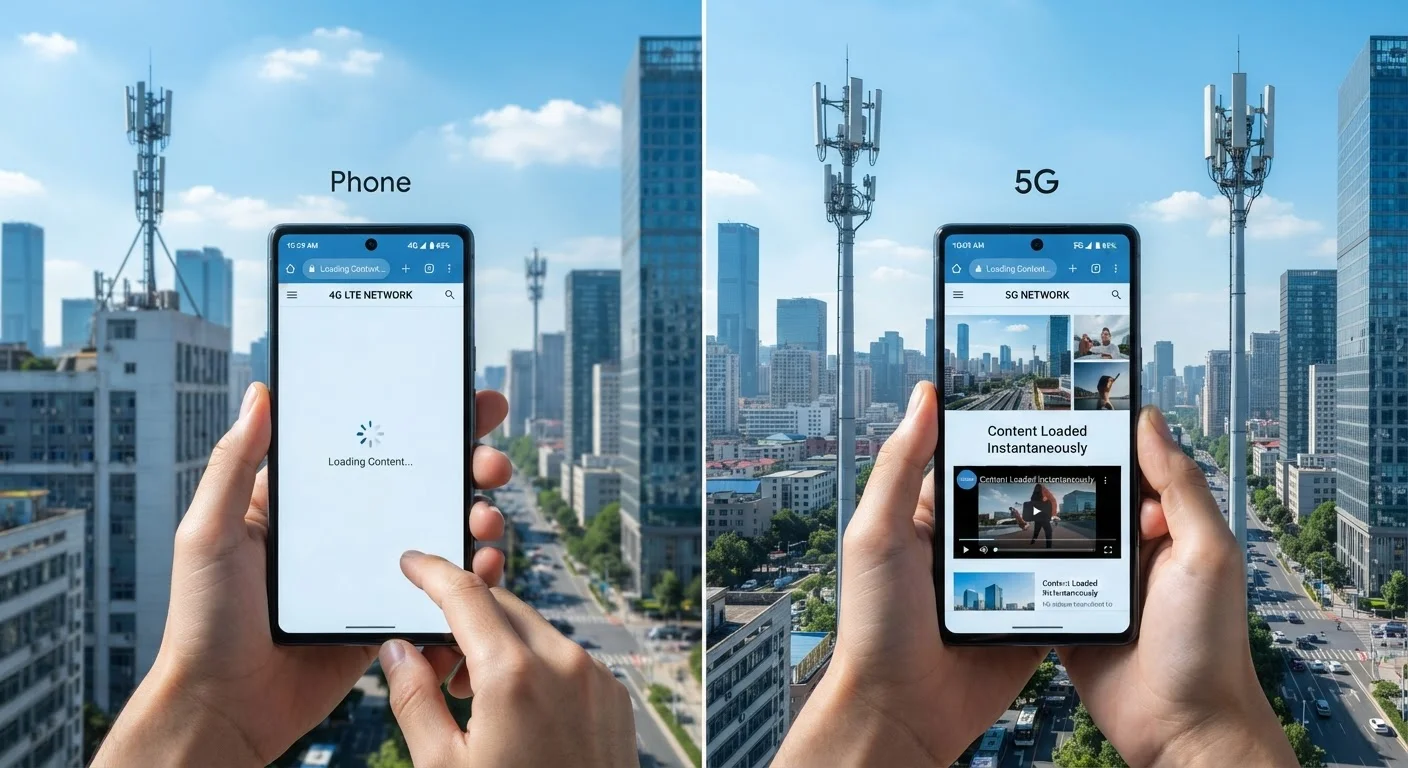
Key Takeaways
- 5G peak speeds far exceed 4G LTE on paper, but real-world gains depend heavily on your location and carrier network.
- Most everyday tasks — messaging, social media, email — perform nearly identically on both technologies.
- 5G coverage remains uneven; many 5G phones regularly connect via 4G LTE when 5G is unavailable.
- Battery drain can be higher on 5G, though chip improvements have narrowed the gap considerably.
- Sub-6 GHz 5G offers broader reach while mmWave 5G delivers extreme speeds only in very specific spots.
Option A
4G LTE
The proven, widespread standard still carrying most mobile traffic.
Best for: Users in rural or suburban areas, those who prioritize battery life, and anyone whose daily tasks don't demand peak download speeds.
Option B
5G
The next-generation network with higher ceilings — and more uneven coverage.
Best for: Urban users near dense 5G infrastructure who stream high-resolution video, use mobile hotspots, or want headroom for emerging applications.
If you live in a rural or suburban area with limited 5G coverage
4G LTE
4G LTE networks are far more mature and consistent outside major metro areas. A 5G plan won't improve daily performance where 5G infrastructure isn't deployed.
If you frequently use your phone as a mobile hotspot in a city
5G
5G's higher throughput translates directly to faster tethered speeds for laptops and tablets, making it genuinely useful for urban mobile workers.
If battery life is your top priority
4G LTE
Keeping your phone on 4G LTE mode can extend battery life, particularly on older 5G hardware where the modem draws more power during 5G connections.
If you stream 4K video or download large files frequently while on the go
5G
5G's higher bandwidth makes data-heavy tasks noticeably faster in areas with strong signal, reducing buffering and download wait times.
If you want future-proofing without paying a significant premium
5G
5G-capable devices are now standard in most mid-range and flagship segments, and carrier networks will continue expanding 5G coverage over time.
Speed on Paper vs. Speed in Your Pocket
Carrier marketing leans hard on peak speed figures. 5G specifications do allow for multi-gigabit downloads, while 4G LTE typically tops out around 150–300 Mbps under ideal conditions. In practice, neither technology reliably hits those peaks in everyday use.
What most users actually experience on mature 4G LTE networks is 20–80 Mbps — more than sufficient for streaming, video calls, and browsing. On sub-6 GHz 5G (the variety covering most 5G users in the US), real-world speeds often land in the 100–300 Mbps range — meaningfully faster, but not the leap suggested by spec sheets. Only mmWave 5G, available in very limited dense-urban hotspots, reaches those multi-gigabit figures. See what separates sub-6 GHz from mmWave 5G for a deeper breakdown of both flavors.
For tasks like loading a webpage, sending messages, or checking social media, the difference between 40 Mbps and 200 Mbps is imperceptible — both complete in under a second. Speed gaps become tangible when downloading a large app update, streaming 4K HDR content, or tethering multiple devices simultaneously.
| Criterion | 4G LTE | 5G |
|---|---|---|
| Typical real-world download speed | 20–80 Mbps | 100–300 Mbps (sub-6 GHz) |
| Peak theoretical speed | ~300 Mbps | Up to 10 Gbps (mmWave) |
| Typical latency | 30–50 ms | 10–30 ms (varies by architecture) |
| Coverage maturity (US) | Extensive, including rural areas | Primarily urban and suburban |
| Indoor signal reliability | Generally consistent | Variable; depends on frequency band |
| Battery impact | Lower draw, stable connection | Moderate; improves on newer chipsets |
| Best for everyday tasks | Fully adequate | Fully adequate |
| Best for data-heavy use | Adequate for most users | Noticeably faster where available |
Latency, Coverage, and Indoor Performance
Latency — the time it takes a data packet to make a round trip — matters more than raw speed for real-time applications like video calls and cloud gaming. 4G LTE typically delivers latency around 30–50 milliseconds. 5G, particularly on Standalone (SA) network architecture, can push that below 10 milliseconds, though most US deployments still run Non-Standalone (NSA) 5G, which relies on 4G LTE's core and sees more modest latency gains. Understanding SA vs. NSA 5G architecture clarifies why two 5G networks can feel very different.
Coverage is where 4G LTE still holds a clear advantage. US carriers have spent over a decade building out LTE infrastructure, and rural gaps have steadily narrowed. 5G rollout, while accelerating, remains concentrated in urban and suburban corridors. As a result, many 5G phones default to 4G LTE connections much of the day — especially indoors, where higher-frequency 5G signals struggle to penetrate walls and windows.
Indoor signal penetration is a real-world limitation worth factoring into any upgrade decision. Indoor 5G signal behavior depends heavily on building materials, distance from a window, and which 5G band your carrier prioritizes in that area.
~80%
US population with 5G coverage access
Major US carriers report broad geographic 5G availability, though coverage depth and speed vary significantly by band and region.
30–50 ms
Typical 4G LTE round-trip latency
Industry benchmarks consistently place 4G LTE latency in this range under normal network load conditions.
10x
5G peak speed advantage over 4G LTE
Under optimal mmWave conditions, 5G theoretical peaks exceed 4G LTE maximums by roughly an order of magnitude — though typical daily gains are far smaller.
Battery Life and What to Realistically Expect
Early 5G modems drew significantly more power than their 4G counterparts, making battery drain a legitimate concern when 5G first launched. Modem efficiency has improved substantially in subsequent chip generations, narrowing the gap — but 5G connections, particularly when the modem is actively searching between 5G and 4G bands, can still consume more battery than a stable 4G LTE connection.
Most modern 5G phones include a network mode setting that allows users to lock the device to 4G LTE when 5G isn't needed — a practical option for days when battery endurance matters more than speed. For a detailed look at the evidence behind 5G's power consumption, the relationship between 5G and battery drain is worth reviewing before drawing conclusions.
The bottom line: 5G hardware has matured enough that battery differences are no longer dealbreakers on current-generation devices, but they remain a factor — especially on older 5G phones or in areas where your device constantly switches between bands. If you are weighing an upgrade, consult a practical 5G upgrade checklist to assess whether the trade-offs make sense for your specific situation.
Not All 5G Is the Same Technology
The '5G' indicator on your phone's status bar can represent very different experiences depending on which frequency band your carrier is using in that location. Low-band 5G offers wide coverage but speeds only modestly above 4G LTE. Mid-band 5G (sub-6 GHz) delivers the most balanced combination of speed and coverage for most urban users. High-band mmWave 5G provides extreme speeds but only in very specific, limited locations. Understanding which type your carrier deploys in your area is key to setting realistic expectations. See our plain-language 5G explainer for more on how these bands differ.