

Key Takeaways
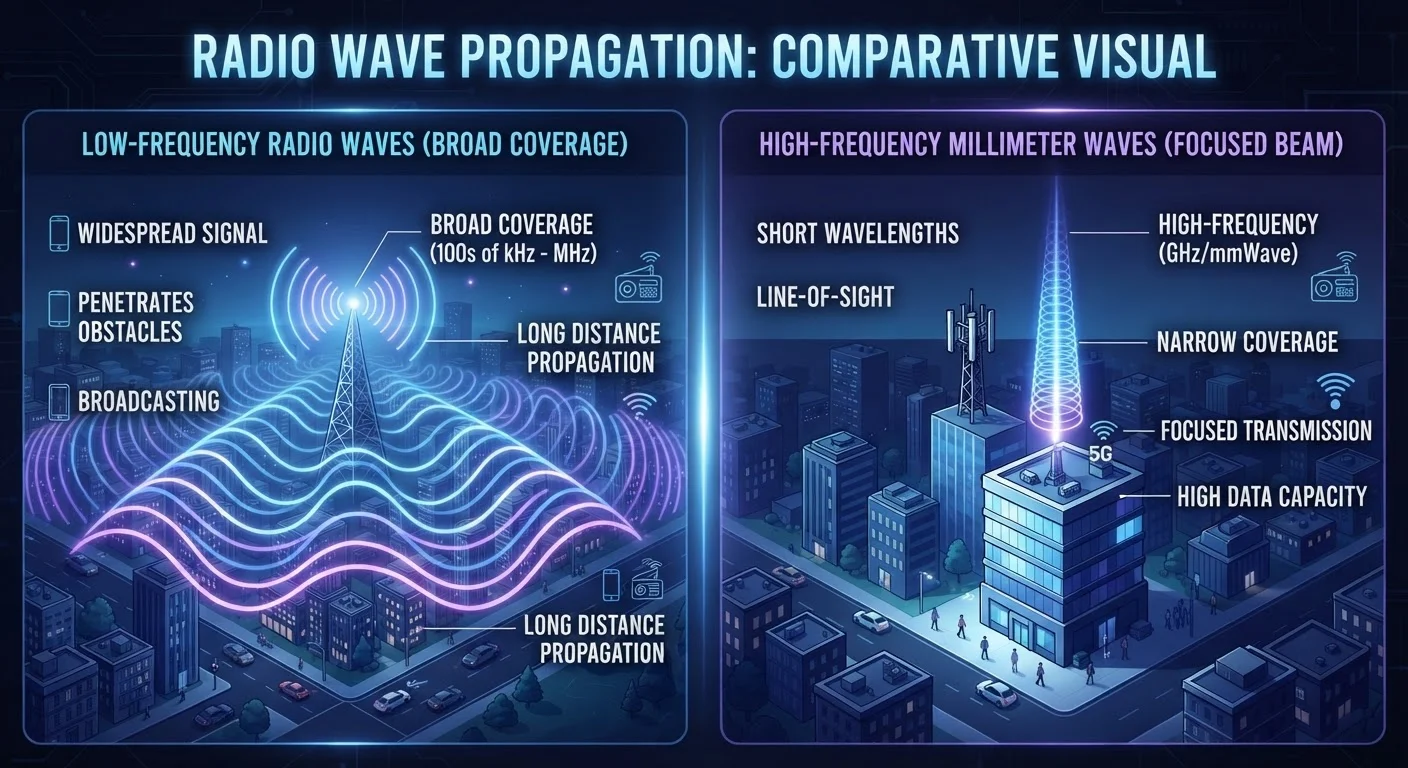
- Sub-6 GHz 5G covers wide areas and penetrates buildings; mmWave offers extreme speeds over very short distances.
- Most consumers encounter sub-6 GHz 5G in daily life; mmWave deployments remain limited to select urban spots.
- Your phone may show a 5G icon regardless of which band it's actually using at any moment.
- mmWave signals are blocked by walls, windows, and even heavy rain, limiting indoor usability.
- The two technologies are complementary — carriers deploy both for different scenarios.
Option A
Sub-6 GHz 5G
The wide-coverage workhorse of 5G.
Best for: Everyday consumers who want reliable 5G across cities, suburbs, and indoors.
Option B
mmWave 5G
The ultra-fast but range-limited specialist.
Best for: Dense urban venues where peak speed and capacity matter more than coverage.
If you want dependable 5G coverage in your everyday environment
Sub-6 GHz 5G
Sub-6 GHz reaches farther, penetrates buildings, and is available across far more locations than mmWave currently is.
If you need maximum throughput in a crowded public venue
mmWave 5G
mmWave's enormous bandwidth can support thousands of simultaneous connections at peak speeds — ideal for stadiums or transit hubs.
If you're choosing a phone plan and comparing 5G coverage maps
Sub-6 GHz 5G
A plan advertising broad 5G coverage almost always means sub-6 GHz; don't expect mmWave speeds unless you're in a documented mmWave zone.
Why 5G Is Not Just One Thing
When a carrier advertises 5G, it's describing a family of technologies — not a single, uniform network experience. Two of the most important members of that family are sub-6 GHz 5G and millimeter wave (mmWave) 5G. Both are genuine 5G, both meet the standard's technical requirements, and both can display a "5G" indicator on your phone. But in real-world terms, they behave so differently that treating them as the same thing leads to disappointed expectations.
For a broader grounding in what 5G actually delivers, see our 5G explainer. This article focuses specifically on the frequency divide that most carrier marketing glosses over.
| Criterion | Sub-6 GHz 5G | mmWave 5G |
|---|---|---|
| Frequency range | Below 6 GHz (typically 2.5–3.7 GHz) | Above 24 GHz |
| Typical real-world speeds | 100–400 Mbps | Up to 1+ Gbps (short range) |
| Coverage radius per tower | Miles | Hundreds of feet |
| Building penetration | Good | Poor — blocked by walls and glass |
| Network deployment breadth | Widespread nationally | Limited to select urban spots |
| Best use scenario | Everyday mobile use | Dense venues requiring high capacity |
| Phone hardware support | Universal in 5G phones | Requires specific modem hardware |
Sub-6 GHz: Coverage First
Sub-6 GHz 5G uses radio frequencies below 6 gigahertz — a range that includes the mid-band frequencies (typically 2.5 GHz to 3.7 GHz) that most carriers have built their 5G networks around. Lower frequencies travel farther from a tower and pass through walls, floors, and windows more effectively than higher-frequency signals do.
In practice, this means sub-6 GHz 5G can cover entire city blocks — or even rural stretches of highway — from a single tower. Speeds in the field generally range from around 100 Mbps to 400 Mbps, depending on network load and local conditions. That's a meaningful step up from much of LTE, though it rarely reaches the headline gigabit figures carriers quote.
~300 ft
Typical mmWave effective range outdoors
Industry technical documentation generally places practical mmWave cell radius at under 300 feet in real-world urban deployments.
~10x
mmWave peak speed vs. typical sub-6 GHz
Under ideal lab and field conditions, mmWave peak throughput can exceed 1 Gbps versus roughly 100–200 Mbps for typical mid-band sub-6 GHz connections.
Sub-6 GHz is the 5G most people are actually using when their phone shows the 5G icon. It's also where carriers have invested most heavily in infrastructure, so coverage is far wider than mmWave.
mmWave: Speed at Close Range
Millimeter wave 5G operates in frequency bands typically above 24 GHz. At these frequencies, signals carry enormous amounts of data — peak speeds exceeding 1 Gbps are achievable — but they attenuate (weaken) very rapidly over distance. A mmWave signal may only travel a few hundred feet from its transmitter under ideal conditions.
More critically, mmWave is easily blocked. Walls, window glass, foliage, rain, and even a hand over the antenna can disrupt the signal entirely. This is why mmWave deployments tend to be concentrated in high-footfall outdoor locations: sports arenas, airport terminals, and dense downtown corridors where transmitters can be mounted close to users.
The upside is genuine: in those specific environments, mmWave can handle massive simultaneous connection loads without degrading, making it well-suited to crowded venues where sub-6 GHz networks become congested. Think of it as a capacity tool rather than a blanket coverage solution. This architectural distinction connects to a broader point about how networks are designed — network architecture choices shape the 5G experience just as much as frequency band selection does.
What This Means for Your Phone and Plan
When you're evaluating a phone or data plan, a few practical points follow from this frequency divide.
- Coverage maps: Most carrier 5G coverage maps represent sub-6 GHz coverage. mmWave zones, where they exist, are often marked separately and cover only small geographic patches.
- Phone hardware: Not every 5G phone supports mmWave. Many devices include sub-6 GHz 5G radios only. If mmWave support matters to you, verify the phone's modem specifications before purchase.
- Indoor use: If you spend most of your time indoors, mmWave provides little practical benefit. Sub-6 GHz is the relevant band for typical home and office environments.
- International travel: mmWave deployments outside the US are sparse. Sub-6 GHz mid-band networks are the global norm for 5G rollouts.
It's also worth noting that the 5G/4G icon on your phone tells you almost nothing about which specific band you're connected to. For more on common misunderstandings about 5G indicators and capabilities, see 5G myths worth debunking. Consumers shopping across connectivity standards may also find this plain-language connectivity reference useful for context.
The "5G" Icon Doesn't Specify the Band
Your phone's status bar shows a single 5G indicator regardless of whether you're connected via sub-6 GHz or mmWave. Some manufacturers added a distinct "5G UW" or "5G+" label for mmWave connections, but this varies by device and carrier. If you want to know which band you're actually on, you typically need to access diagnostic menus or a network analysis app — not the standard status bar.