

| Zigbee frequency | 2.4 GHz |
| Z-Wave frequency (US) | ~908 MHz |
| Z-Wave max devices per network | 232 (Z-Wave Alliance specification) |
| Bluetooth LE typical range | Up to ~30 ft (10 m) (Varies with environment and hardware) |
| Hub required for Zigbee | Yes |
| Hub required for Wi-Fi devices | No |
| Mesh networking support | Zigbee, Z-Wave, Bluetooth Mesh |
Why Protocol Choice Actually Matters
Every smart device in your home communicates using a wireless protocol - a standardized set of rules that determines how signals are sent, how far they travel, and how much power they consume. When devices use incompatible protocols, they simply can't talk to each other, no matter how sophisticated each one is individually.
The four protocols you'll encounter most often are Wi-Fi, Zigbee, Z-Wave, and Bluetooth. A newer standard called Matter is also gaining traction by sitting on top of existing protocols - see what Matter actually does for more on that. This guide focuses on the four core protocols and when each makes sense.
| Zigbee frequency | 2.4 GHz |
| Z-Wave frequency (US) | ~908 MHz |
| Z-Wave max devices per network | 232 (Z-Wave Alliance specification) |
| Bluetooth LE typical range | Up to ~30 ft (10 m) (Varies with environment and hardware) |
| Hub required for Zigbee | Yes |
| Hub required for Wi-Fi devices | No |
| Mesh networking support | Zigbee, Z-Wave, Bluetooth Mesh |
Zigbee and Z-Wave: The Hub-Dependent Standards
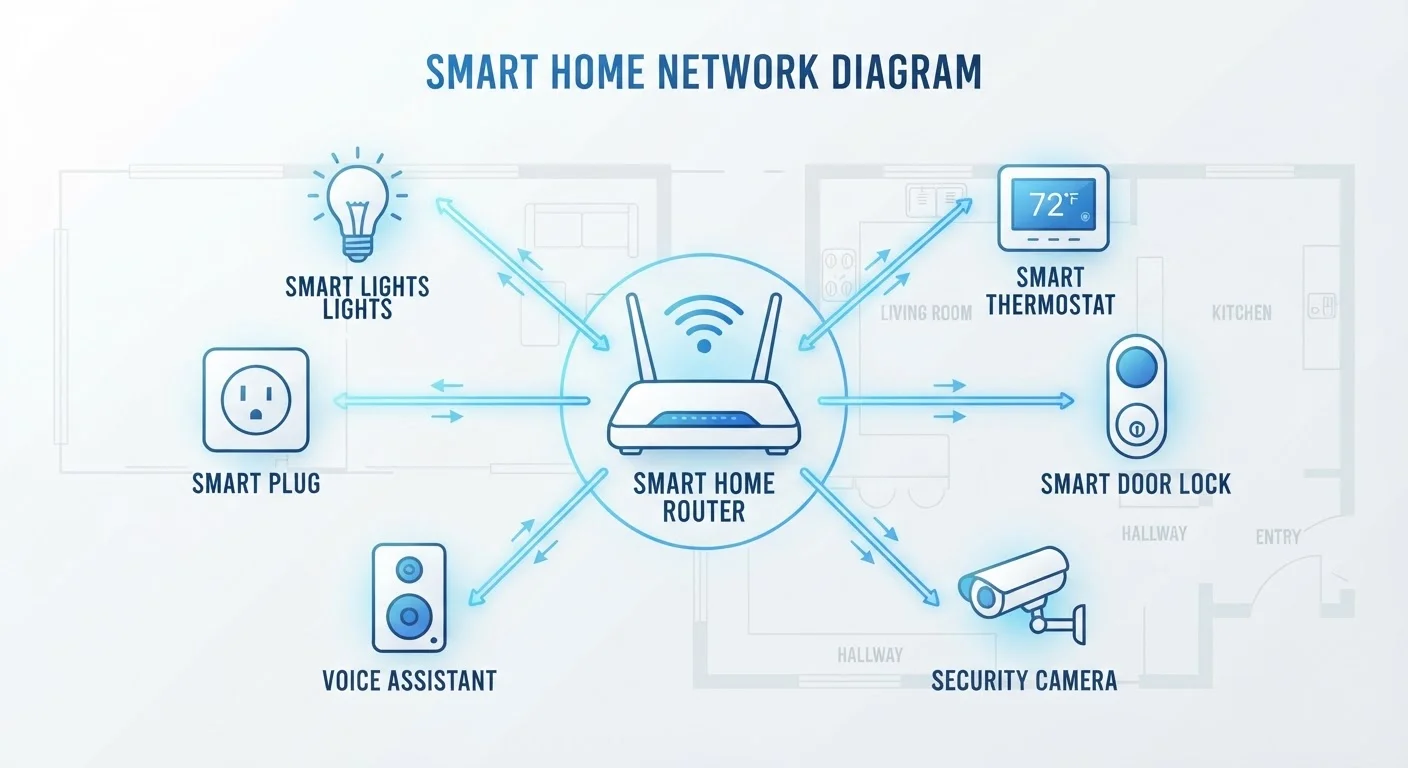
Zigbee and Z-Wave are both designed specifically for smart home use. Neither connects directly to a standard home router - each requires a compatible hub or bridge to translate signals between the device network and your internet connection.
Wireless protocol
A set of rules governing how devices send and receive wireless signals. Protocols define frequency, range, power use, and how devices are identified on a network.
Mesh network
A network architecture where each device can relay signals to and from other devices, extending overall range without requiring every device to connect directly to a central hub.
Hub (smart home)
A central device that translates signals between a local smart home protocol (like Zigbee or Z-Wave) and your home's internet connection, enabling remote control and automation.
Bluetooth Low Energy (BLE)
A power-efficient variant of Bluetooth designed for devices that transmit small amounts of data infrequently, such as sensors and smart locks.
Sub-GHz frequency
Radio frequencies below 1 GHz, such as the ~908 MHz band used by Z-Wave in the US. These frequencies experience less household interference than 2.4 GHz signals.
Zigbee operates on the 2.4 GHz band and uses a mesh networking model: devices relay signals through each other, extending range throughout a home. It supports hundreds of devices on a single network and is widely used in smart lighting, sensors, and plugs. The trade-off is mild interference risk from Wi-Fi and Bluetooth, which also operate on 2.4 GHz.
Z-Wave operates on sub-gigahertz frequencies (around 908 MHz in the US), which means virtually no interference from other household wireless signals. Its mesh network typically limits each network to 232 devices - plenty for most homes. Z-Wave devices from certified manufacturers are guaranteed to interoperate, which is a meaningful advantage for long-term reliability. For context on how hub-based setups compare to direct Wi-Fi devices, see smart home hubs vs. direct Wi-Fi devices.
Wi-Fi and Bluetooth: The No-Hub Options
Wi-Fi smart devices connect directly to your home router, skipping the need for a separate hub. Setup is usually straightforward - install the device, connect to your network, and it's online. The downsides are real, though: Wi-Fi devices draw more power (problematic for battery-operated sensors), and adding many devices can strain a congested network. Understanding your router's capabilities matters here - Wi-Fi standards and what they mean for your devices covers the underlying technology in more depth.
2.4 GHz
Shared band for Wi-Fi, Zigbee, and Bluetooth
All three competing on the same frequency band can cause interference in dense device environments.
~10×
Relative power draw: Wi-Fi vs. Zigbee/Z-Wave sensors
Wi-Fi radios consume significantly more power, making them less suitable for battery-powered sensors compared to low-power alternatives.
Bluetooth, and specifically Bluetooth Low Energy (BLE), is common in devices where short-range communication and battery efficiency are priorities - think smart locks, fitness sensors, and some bulbs. Range is limited to roughly 30 feet under ideal conditions, though Bluetooth Mesh can extend this by chaining devices together. Bluetooth typically works without a hub but usually requires a smartphone or smart speaker as a local controller.
Understanding which protocol a device uses before purchasing helps you plan a compatible, expandable setup. See smart home device categories and their roles to map protocol choices to specific device types.