

Key Takeaways
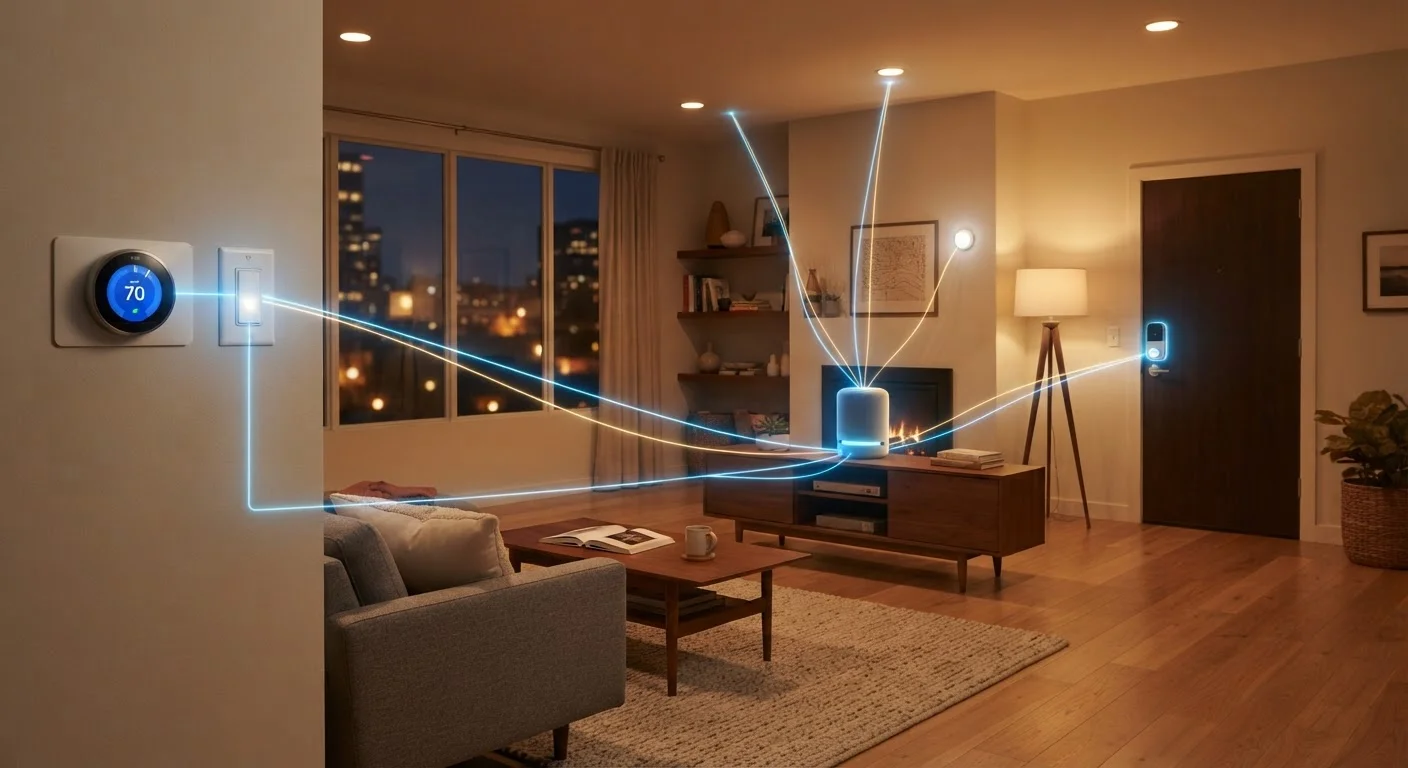
- Matter is an industry-backed standard that allows devices from different brands to work together natively.
- It runs over Wi-Fi and Thread, so most homes don't need entirely new hardware to support it.
- Major platform providers - including Google, Apple, Amazon, and Samsung - all support Matter.
- Matter-certified devices can be controlled by multiple smart home apps simultaneously.
- Not all device categories are covered by Matter yet; the standard continues to expand.
Matter Protocol
Matter is an open-source connectivity standard designed to make smart home devices from different manufacturers work seamlessly with each other. Instead of being locked into one brand's ecosystem, a Matter-certified device can communicate with other certified products regardless of who made them. It runs over existing home networks using Wi-Fi, Thread, and Ethernet.
Matter operates at the application layer of the network stack, meaning it defines how devices describe their capabilities and exchange commands - not the underlying radio technology itself.
Why Smart Home Compatibility Has Been a Problem
For years, buying a smart home device meant committing to an ecosystem. A light bulb from one brand wouldn't respond to a hub from another. Automations were possible only within walled gardens, and switching platforms often meant replacing hardware entirely.
This fragmentation wasn't accidental - it reflected how manufacturers competed. Proprietary protocols and closed ecosystems created customer lock-in. The result: consumers faced a confusing patchwork of apps, hubs, and incompatible products.
Understanding how these systems relate to one another is essential context. Our article on how smart home ecosystems work explains the foundational dynamics that Matter is designed to address.
280+
Member companies in the Connectivity Standards Alliance
The CSA, which oversees the Matter standard, includes major platform providers, chip makers, and device manufacturers among its membership.
4
Major platforms supporting Matter at launch
Apple, Google, Amazon, and Samsung all committed to Matter support, making it the first smart home standard to launch with cross-platform backing from all major ecosystems simultaneously.
What Matter Actually Does
Matter, formerly known as Project CHIP (Connected Home over IP), is a royalty-free standard maintained by the Connectivity Standards Alliance (CSA). Its core function is to define a shared language - a common set of commands, data models, and security requirements - that certified devices must support.
When a device is Matter-certified, it can announce its capabilities in a way that any compatible controller can understand. A certified thermostat knows how to receive a "set temperature" command regardless of which app sent it. That standardization happens at the application layer, sitting above the physical radio technologies.
Matter currently uses three transport layers: Wi-Fi for high-bandwidth or mains-powered devices, Thread for battery-powered sensors and low-power accessories, and Ethernet for wired infrastructure like hubs. Bluetooth Low Energy is used only for the initial device setup process, not for ongoing control.
Matter Requires Internet-Based IP Networking
Unlike Zigbee or Z-Wave, which can operate without an internet connection over their own radio frequencies, Matter is built on IP (Internet Protocol) networking. Local control is supported - Matter devices can operate over your home's local network without cloud dependency - but the underlying infrastructure relies on Wi-Fi or Thread rather than standalone mesh radios. This is generally an advantage for reliability, but it means your home router is part of the equation.
Multi-Admin: One Device, Many Controllers
One of Matter's most significant practical features is multi-admin - the ability for a single device to be controlled by multiple platforms at once. A Matter-certified smart lock can live in both Apple Home and Google Home simultaneously, responding correctly to commands from either and syncing its state across both.
This matters because households don't always agree on a single platform. One person might use Siri while another prefers Google Assistant. Multi-admin removes the requirement to choose - and it removes the anxiety of building a setup that becomes incompatible if you later switch phones or voice assistants.
What Matter Doesn't Solve
Matter is not a cure-all for smart home complexity. A few important limitations are worth understanding before adjusting expectations:
- Not all device categories are covered. Security cameras, robot vacuums, and many appliances are outside the current specification. Coverage is expanding, but the standard is still maturing.
- Legacy devices largely stay behind. Devices without Matter support won't gain it unless manufacturers issue firmware updates - and many won't.
- Platform-specific features remain. Matter defines a baseline. Advanced features - custom automations, platform-specific routines - are still ecosystem-dependent and may not transfer across controllers.
- Setup still requires a hub or border router. Thread devices need a Thread Border Router, which is embedded in some smart speakers and hubs but not universally available.
For a realistic perspective on what smart home technology can and can't do today, see our full-picture overview of smart home living.
Look for the Matter Badge When Buying
When shopping for new smart home devices, check product packaging or listings for the Matter certification logo - a stylized 'M' mark administered by the CSA. Certification indicates the device has passed interoperability testing, not just that it claims Matter support. This distinction is worth noting, as some products advertise compatibility loosely before completing formal certification.
How Matter Fits Into the Broader Protocol Landscape
Matter complements rather than replaces existing wireless protocols. Zigbee and Z-Wave devices already in homes continue to work through their native hubs - Matter doesn't retroactively absorb them. What changes is that new devices built on Matter or Thread no longer require a manufacturer-specific bridge to become part of your setup.
It's also worth separating Matter from Wi-Fi standards - two different layers of technology that are sometimes confused. Wi-Fi standards like Wi-Fi 6 and Wi-Fi 7 affect speed and network capacity; Matter defines what devices say to each other once they're connected. Both matter to a well-functioning smart home, but they solve different problems.
If you're evaluating smart home purchases and want to separate hype from reality, our guide to common smart home myths is worth reading alongside this one. Matter is a genuine step forward - but it works best when consumers approach it with accurate expectations.
“The goal of Matter is straightforward: a device with the Matter logo should work with any Matter-compatible ecosystem, giving consumers genuine choice and flexibility.”
— Connectivity Standards Alliance, Industry consortium overseeing the Matter specification