

Key Takeaways
- Projectors struggle in bright rooms; large-screen TVs handle ambient light far better.
- A projector's running costs include lamp or laser replacement, which TVs don't require.
- TVs deliver higher peak brightness and more consistent color accuracy out of the box.
- Projectors can exceed 100" diagonally at a fraction of the cost of comparable-size TVs.
- Setup complexity, throw distance, and room geometry all affect projector viability.
- Both technologies have matured significantly, but each suits a distinct viewer profile.
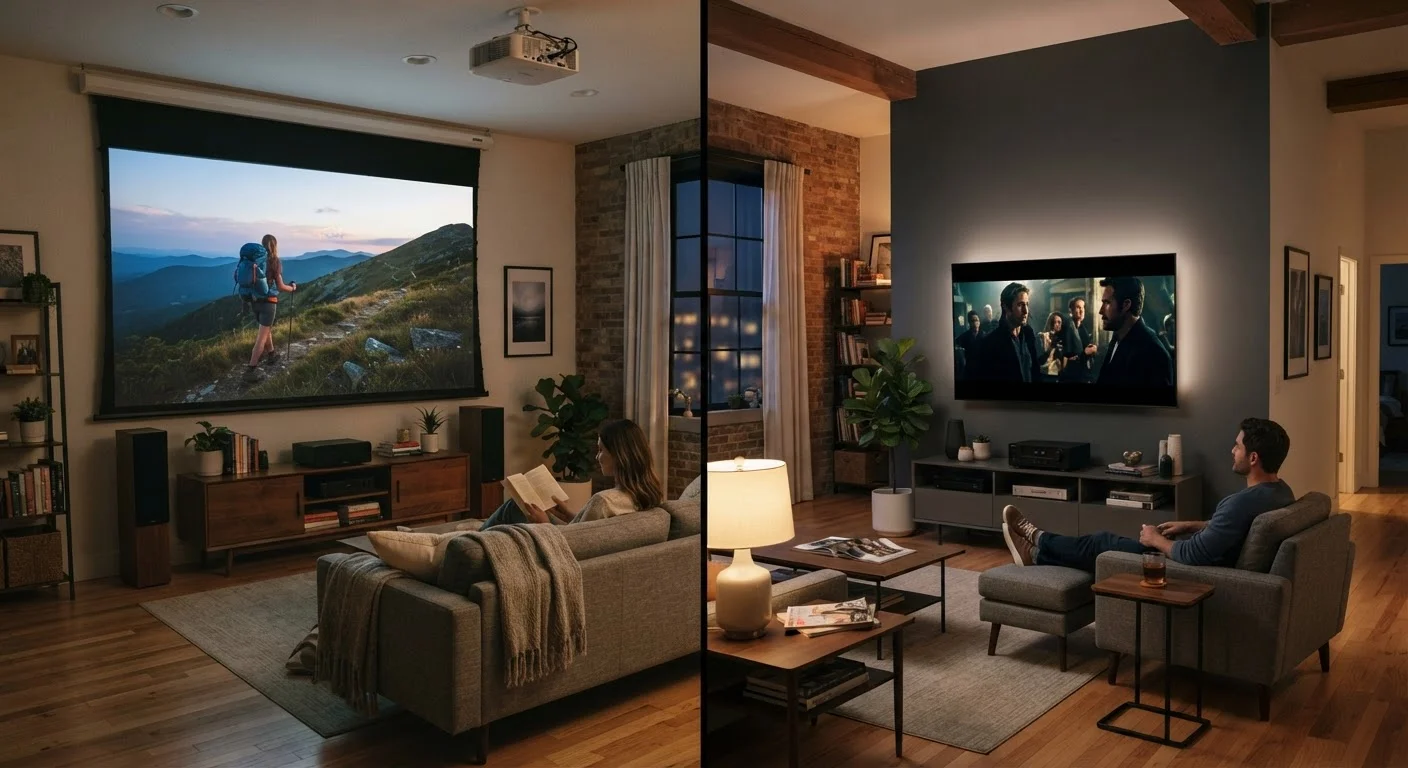
Option A
Home Projector
The flexible, cinema-scale option for controlled environments.
Best for: Dedicated home theater rooms or spaces where ambient light can be managed and a large image (100"+ diagonal) is the priority.
Option B
Large-Screen TV (75"-98")
The plug-and-play powerhouse built for everyday viewing in any room.
Best for: Living rooms, bright spaces, or households that watch throughout the day without setting up a dedicated viewing environment.
If you want a true cinema-scale image on a tight budget
Home Projector
A projector can deliver a 100"+ image at a cost that no comparably sized TV can match, making screen real estate affordable.
If your room gets significant natural or overhead light during viewing
Large-Screen TV
TVs produce far higher peak brightness and are engineered with anti-reflective coatings, making them vastly more usable in lit environments.
If you want to unbox, mount, and start watching the same day
Large-Screen TV
TVs require no throw-distance planning, screen installation, or room darkening - setup is straightforward and image quality is immediate.
If you have a dedicated, light-controlled media room
Home Projector
In a dark room, modern laser projectors produce a deeply immersive experience that even large TVs cannot replicate in terms of sheer scale.
If long-term ownership costs and maintenance matter most
Large-Screen TV
TVs have no consumable light sources; projector lamps or even laser light engines degrade over time and may require eventual replacement.
The Real Differences Start Before You Press Play
When most people compare a projector to a large-screen TV, they focus on screen size. That's understandable - the ability to fill a wall is genuinely compelling. But the meaningful differences between these two display approaches run much deeper than diagonal inches.
Room conditions, installation requirements, image technology, and ongoing costs all shift significantly depending on which path you choose. Understanding those factors helps you avoid a purchase that looks great in a showroom but underperforms in your actual home.
| Criterion | Home Projector | Large-Screen TV (75"-98") |
|---|---|---|
| Usable screen size | 80"-150"+ diagonal | 75"-98" diagonal |
| Ambient light tolerance | Low - needs dark room | High - works in bright rooms |
| Peak brightness | Lower (typically 1,000-3,000 lumens) | Higher (500-2,000+ nits) |
| Setup complexity | High - throw distance, screen needed | Low - mount and connect |
| HDR performance | Limited by brightness ceiling | Strong, especially OLED/QLED |
| Running costs | Lamp/laser replacement possible | Minimal - no consumables |
| Portability | Can be moved or stored | Fixed installation |
| Cost per screen inch | Lower at large sizes | Higher at large sizes |
Ambient Light: The Projector's Biggest Challenge
Projectors work by bouncing light off a surface - and competing light sources in the room dilute that image. Even a modest amount of window light or overhead lighting can wash out contrast and color on a projected image, turning a vibrant picture into something flat and muddy.
Large-screen TVs, by contrast, are self-emissive displays. They push light directly at your eyes rather than reflecting it. Peak brightness on modern TVs - often measured in nits - is dramatically higher than what most consumer projectors achieve. For a deeper look at how brightness and HDR performance interact in real rooms, see our guide on choosing a TV for a bright room.
Ultra-short-throw (UST) laser projectors narrow this gap somewhat, but a fully darkened or heavily curtained room remains the projector's native habitat. If your living room faces south or you watch news in the morning, this matters enormously.
100"+
Typical projector screen diagonal
Consumer projectors commonly produce images between 100" and 150" diagonal - a size range unavailable in any mass-market TV.
2,000-5,000 hrs
Traditional projector lamp lifespan
Lamp-based projectors typically require bulb replacement within this range, adding to total ownership cost over time.
1,000+ nits
Peak brightness on flagship TVs
High-end LED and OLED televisions regularly exceed 1,000 nits peak brightness, far outpacing most consumer projector outputs in lit environments.
Setup, Space, and Installation Reality
A 75" TV requires wall mounting or a TV stand and an HDMI source - that's most of the installation. A projector requires considerably more planning. You need to calculate throw distance (the gap between the projector lens and the screen surface), which varies by model and lens type. Standard-throw projectors may need to sit eight to twelve feet from the screen; UST models can sit inches away.
You also need a screen - either a wall-mounted pull-down screen or a fixed-frame screen - or a suitable flat, white wall surface. Ceiling mounting the projector adds further complexity, including running cables cleanly through walls or ceilings. In practice, projector setups benefit from deliberate room planning that TV installations simply don't require.
For households that want flexibility - moving furniture, using the space for other purposes, changing the room layout - a large-screen TV is significantly less constraining.
Image Quality: Where Each Technology Excels
Modern 4K TVs - whether OLED, QLED, or LED-based - deliver exceptional sharpness, deep blacks, and wide color gamuts that are tuned and calibrated at the factory. Panel technologies differ in meaningful ways; if you want a breakdown of how OLED compares to QLED and LED, our article on TV panel technology explains what each approach actually changes in practice.
Projectors have improved dramatically, particularly laser-based models that offer better color consistency and longer light-source lifespans than traditional lamp projectors. But at equivalent price points, a TV will generally outperform a projector on contrast, color accuracy, and HDR rendering - largely because HDR requires peak brightness that projectors struggle to deliver.
Where projectors win is scale and the subjective sensation of immersion. At 120" diagonal, even a good-but-not-exceptional projector produces a cinematic experience that no TV currently matches in physical size at a comparable price. The TV specs that actually matter guide can help you understand which numbers to weigh when evaluating either type of display.
Ultra-Short-Throw Projectors: A Middle Ground
Ultra-short-throw (UST) laser projectors sit just inches from the screen surface, reducing the installation footprint significantly. They also achieve higher brightness than traditional projectors, narrowing - though not closing - the ambient light gap with TVs. UST models tend to cost considerably more than standard-throw projectors, often approaching or exceeding large-screen TV pricing at equivalent image quality levels. They represent a genuine option for rooms where ceiling mounting isn't possible but large-scale images are still desired.
Running Costs and Long-Term Ownership
TVs have no consumable components under normal use. A modern LED or OLED panel is rated for tens of thousands of hours of operation before brightness noticeably degrades, and there are no parts to replace during the typical ownership window.
Projectors - even laser models - have a finite light source lifespan. Traditional lamp projectors may require bulb replacement every 2,000-5,000 hours, and replacement lamps carry a meaningful cost. Laser projectors have much longer rated lifespans (often 20,000+ hours), but the light engine is not user-replaceable in most consumer models.
Additionally, projectors often require periodic recalibration as the light source ages and color shifts. For long-term, low-maintenance ownership, the TV is the more straightforward choice. For dedicated enthusiasts willing to manage a more involved setup, a projector's immersive scale can justify the added upkeep.