

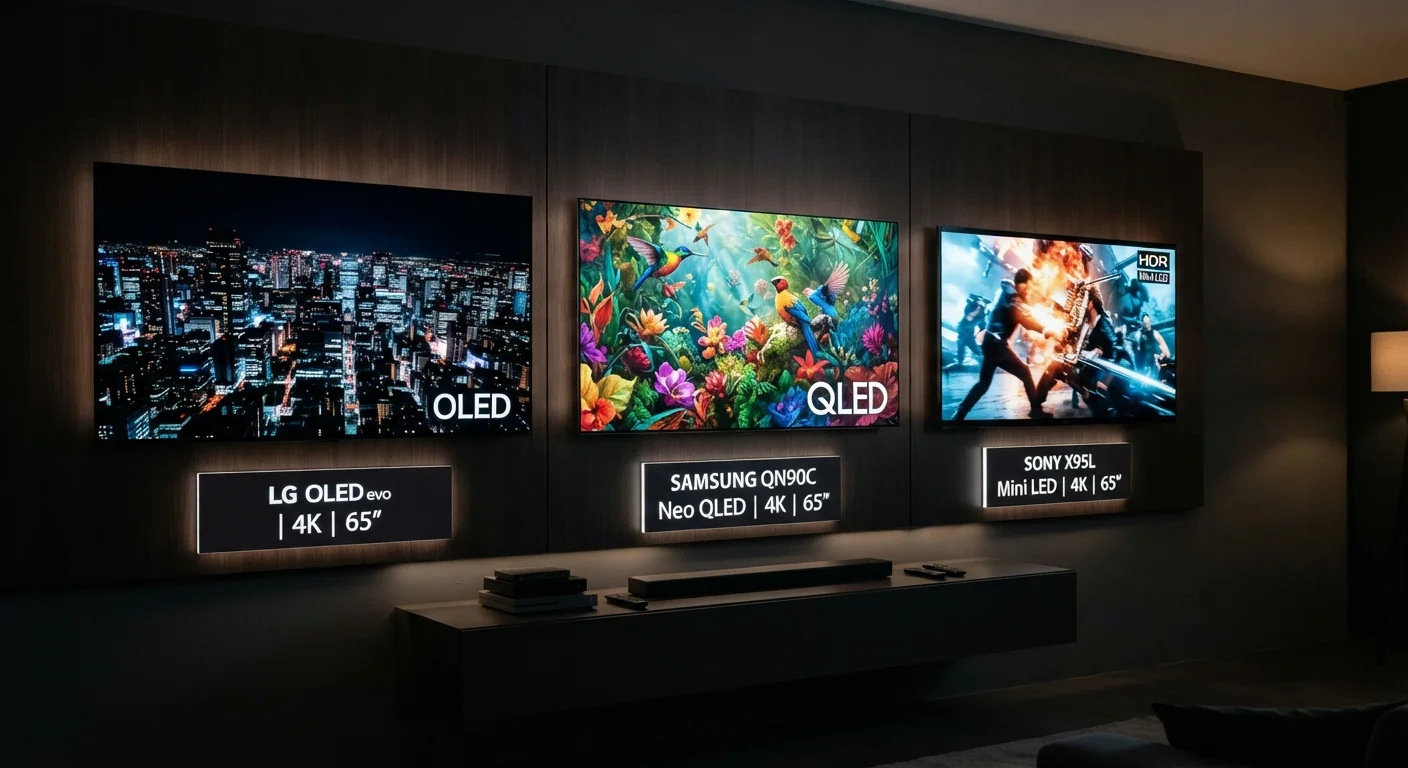
Key Takeaways
- LED TVs are the most widely available and affordable panel type, using a backlight behind an LCD layer.
- QLED adds a quantum dot filter to LED panels, boosting color volume and peak brightness significantly.
- OLED pixels emit their own light individually, enabling true black levels and exceptional contrast.
- Room lighting and viewing habits should guide your panel choice as much as picture quality specs.
- Burn-in risk exists for OLED but is far less common in typical home viewing scenarios than early reports suggested.
Our Verdict
Each panel technology makes a meaningful trade-off: LED suits bright rooms on a budget, QLED pushes brightness and color volume for HDR-heavy content, and OLED delivers the most precise contrast and viewing angles for controlled-light environments. No single type wins outright - the right choice depends on your room, content habits, and how long you plan to keep the TV.
| Best for | Recommended |
|---|---|
| Bright living rooms with lots of ambient light | QLED |
| Home theater or dim-room cinephiles who want precision contrast | OLED |
| Everyday viewing on a tighter budget | LED |
| Sports and gaming with fast motion in mixed lighting | QLED |
How Each Panel Technology Actually Works
Understanding why these three panel types look different starts with understanding how they produce light and color - not just how they're marketed.
LED (LCD with LED backlight): What the industry calls an "LED TV" is technically an LCD panel illuminated by LED lights behind or around the screen. The liquid crystals don't emit light themselves - they block or pass light from the backlight. This means blacks are limited by how well the panel can block that persistent backlight glow.
QLED: QLED is an evolution of LED/LCD, not a replacement for it. A layer of quantum dots - nanoscale semiconductor particles - sits between the backlight and the LCD panel. When the LED backlight hits these dots, they re-emit light at precise wavelengths, producing a wider and more accurate color gamut and allowing for higher peak brightness levels than standard LED panels.
OLED (Organic Light-Emitting Diode): Each pixel in an OLED display is its own light source. When a pixel needs to be black, it simply turns off entirely. There's no backlight to bleed through. This fundamental difference is why OLED contrast ratios are so dramatically different from LCD-based panels. For more on how the same OLED principle applies to smartphone screens, see how OLED and LCD compare on smartphones.
Picture Quality: Where the Differences Show Up
The engineering differences translate directly into real viewing experiences across four key dimensions:
Contrast and Black Levels
OLED's pixel-level dimming produces effectively infinite contrast ratios. LED and QLED panels rely on local dimming zones - clusters of LEDs that can dim independently - but light still bleeds between zones, creating a "halo" effect around bright objects on dark backgrounds. The more dimming zones a panel has, the less visible this artifact becomes, but it's rarely eliminated entirely.
Brightness and HDR Performance
QLED panels consistently reach higher peak brightness levels than OLED, which matters for HDR content in well-lit rooms. OLED's organic materials have physical brightness limits. In a dark room, OLED's contrast advantage tends to offset its brightness ceiling - but in a sunlit living room, QLED's raw output is a practical advantage.
Color Volume and Accuracy
Quantum dots allow QLED panels to maintain color saturation at high brightness levels, a property called color volume. OLED panels produce highly accurate colors across a wide gamut but can lose some saturation as brightness climbs. Both technologies exceed the color performance of standard LED panels by a meaningful margin.
Viewing Angles
OLED panels maintain consistent color and contrast when viewed off-axis. Most LCD-based panels - including QLED - use VA (Vertical Alignment) or IPS panel subtypes, each with different angle trade-offs. VA offers better contrast but narrower angles; IPS offers wider angles but weaker contrast. Panel subtype matters as much as backlight technology for households where viewers sit at varied positions.
| LED | QLED | OLED | |
|---|---|---|---|
| Black levels | Limited by backlight bleed | Improved with local dimming zones | True black - pixels turn off fully |
| Peak brightness | Moderate | High - strong HDR performance | Lower ceiling than QLED |
| Color volume | Standard color gamut | Wide gamut at high brightness | Wide gamut, narrows at peak brightness |
| Viewing angles | Varies by panel subtype | Varies by panel subtype | Consistent off-axis performance |
| Burn-in risk | None | None | Low in typical use; possible with static images |
| Typical price range | Most affordable | Mid to premium | Premium |
| Best room environment | Any lighting condition | Bright or mixed lighting | Dim or controlled lighting |
Longevity, Burn-In, and Practical Durability
One of the most frequently raised concerns about OLED is burn-in - the permanent retention of static image elements (like news tickers or game HUDs) that are displayed for extended periods. The risk is real but has been substantially reduced through pixel-refreshing algorithms and panel improvements over successive generations. Typical varied home viewing habits rarely produce burn-in in practice.
Burn-In Depends Heavily on Usage Patterns
If you regularly watch channels with persistent on-screen graphics - 24-hour news, sports score overlays, or static game menus left on for extended periods - OLED burn-in risk is more relevant. Occasional exposure to static content is not typically a concern. Evaluate your actual viewing habits honestly rather than relying on either worst-case or best-case claims.
LED and QLED panels don't face burn-in risk. Their backlight LEDs do gradually dim over years of use, but this degradation is typically slow and uniform across the screen. OLED panels can also experience gradual brightness reduction over time, though for most users this occurs well past the point where they would have replaced the TV for other reasons.
Panel technology also intersects with resolution and calibration. A well-calibrated LED TV will often outperform a poorly calibrated QLED out of the box - see why factory TV settings underperform for context on getting the most from any panel type. Panel choice is only one variable among many that shape your actual picture quality.
Choosing Based on Your Room and Habits
Panel technology interacts with your specific environment in ways that matter more than spec-sheet numbers alone.
Match the Panel to the Room First
Before comparing contrast ratios or color gamuts, assess where your TV will live. A dim, light-controlled room lets OLED's contrast advantages fully express themselves. A bright, window-heavy room often makes QLED's peak brightness more practically valuable than OLED's black levels. No panel technology can fully compensate for a mismatched environment.
Room lighting: Bright rooms with large windows favor QLED's peak brightness advantage. Dedicated home theater rooms or spaces where you control the lighting let OLED's contrast strengths shine without the brightness limitation becoming a real constraint.
Content habits: Varied streaming content, sports, and gaming involve constantly changing imagery that minimizes any burn-in concern. Extended static gaming HUDs or leaving a news channel running for hours daily would warrant more caution with OLED.
Screen size and budget: OLED panels are produced in a narrower range of sizes and carry a price premium over comparable LED and QLED options. LED panels remain the most accessible across a wide range of screen sizes and price points. For a broader look at which specifications actually justify spending more, see our breakdown of TV specs that matter.
Resolution is a separate but related dimension - panel type determines contrast and color, while resolution determines image sharpness. Both shape what you see. Our guide to TV resolution covers that side of the picture.