

Key Takeaways
- IP68 means a device passed a manufacturer-defined submersion test, not that it's permanently waterproof.
- Water resistance degrades over time as seals wear from everyday use and drops.
- Lab drop tests use specific heights and surfaces that rarely replicate how phones actually fall.
- Manufacturer warranties typically exclude liquid and physical damage even on highly rated devices.
- No single rating covers every real-world durability scenario — multiple metrics are needed.
- Understanding what a rating doesn't cover is just as important as knowing what it does.
Smartphone Durability Ratings
Durability ratings are standardized scores that describe how well a device withstands specific environmental hazards — most commonly water, dust, and physical impact. The most widely cited system is the IP (Ingress Protection) rating, which comes from the IEC 60529 standard. Drop-test ratings, when they exist, typically reflect performance under controlled laboratory conditions.
IP ratings are issued by the International Electrotechnical Commission (IEC) and consist of two digits: the first covers solid particle resistance (0–6), the second covers liquid ingress resistance (0–9K). A device rated IP68 resists dust completely and can withstand submersion beyond 1 meter, with exact depth and duration set by the manufacturer — not by the standard itself.
How the IP Rating System Works
The IP (Ingress Protection) rating on a smartphone spec sheet comes from IEC standard 60529, a globally recognized framework for classifying how well an enclosure resists solid particles and liquids. The two-digit code is straightforward once you know what each digit represents.
The first digit (0–6) describes dust and solid particle resistance. A '6' — the maximum — means no dust ingress under test conditions. The second digit (0–9K) describes liquid resistance. A '7' indicates submersion up to 1 meter for 30 minutes. An '8' means the device can withstand deeper submersion, but the specific depth and duration are defined by the manufacturer, not the standard itself.
This is a critical distinction. When a manufacturer publishes IP68 specifications, the conditions (say, 1.5 meters for 30 minutes) are self-reported. One brand's IP68 benchmark may differ meaningfully from another's. The IEC standard sets the test methodology, not the pass threshold for depth. Consumers comparing two IP68 devices across brands should check the manufacturer's stated conditions, not assume equivalence.
IP Ratings Use Freshwater, Not Real-World Liquids
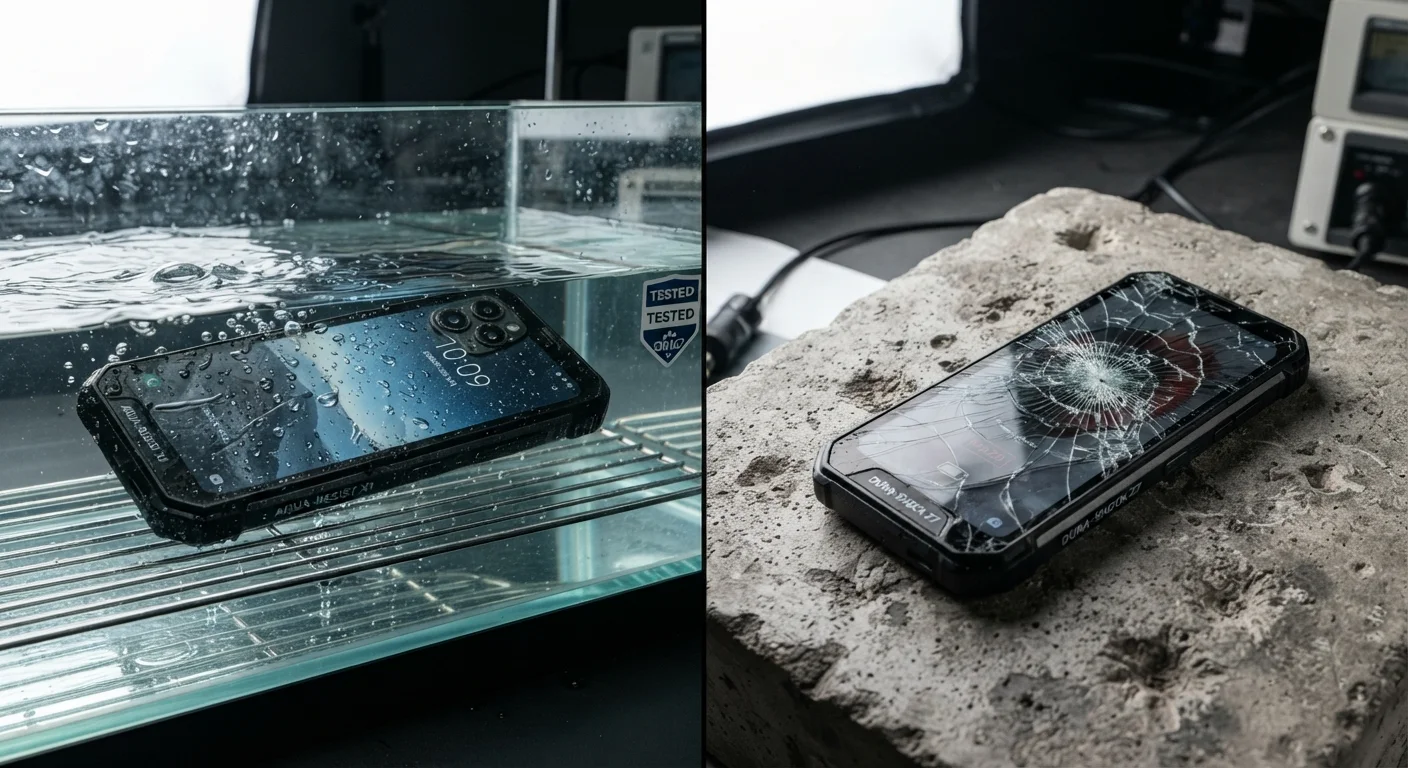
The IEC 60529 standard uses still, clean freshwater for liquid ingress testing. Saltwater, chlorinated pool water, pressurized jets, and beverages are not part of the test protocol. Exposure to these liquids can damage seals and internal components even on devices with high IP ratings, and such damage is typically excluded from warranty coverage.
Also absent from IP testing: high-pressure water jets in everyday scenarios, steam, saltwater, and chemical liquids. The test medium is still, clean freshwater — conditions rarely encountered in real life.
Drop Tests: What Labs Measure and What They Miss
Unlike IP ratings, there is no single universal drop-test standard for consumer smartphones. Some manufacturers reference MIL-STD-810G or MIL-STD-810H — US military environmental testing protocols — while others publish proprietary results from internal or third-party labs.
MIL-STD-810 covers a broad set of environmental stressors, including shock, vibration, humidity, and altitude. Manufacturers can self-certify compliance and select which test procedures to apply. A phone marketed as MIL-STD-810H compliant may have been tested for temperature range and vibration, but not drop impact — the standard permits this flexibility. The label, by itself, doesn't define a minimum toughness level.
Controlled drop tests typically drop a device from a fixed height — often 1 to 1.5 meters — onto a flat, hard surface at a defined angle. Real-world drops are far messier: phones hit pavement at oblique angles, land on edges or corners, or strike irregular surfaces like gravel or tile grout. Corner impacts, widely regarded as the most damaging, are underrepresented in standardized test protocols.
Supplement Ratings With Physical Protection
No IP or drop rating eliminates the benefit of a case and screen protector. Cases redistribute impact force across a wider surface, and tempered glass protectors absorb screen stress before it causes cracks. For most users, these additions provide more consistent real-world protection than any single factory rating.
Third-party stress tests from independent reviewers can supplement manufacturer claims, though they also use non-standardized methods. Treat all drop ratings as indicative, not definitive.
The Hidden Limits of Durability Ratings
Even a perfectly accurate rating at time of purchase degrades over the device's lifetime. IP-rated seals are made of adhesives and gaskets that wear with use. Repeated drops, temperature cycling, and even wireless charging heat can compromise seals over months and years. A device that passed IP68 testing when new may not maintain that resistance after a year of regular use.
Manufacturer warranties compound this gap. Standard warranties on most smartphones explicitly exclude liquid and physical damage — including on devices marketed with high IP scores. Internal liquid contact indicators (small stickers that change color when wet) are routinely checked by service technicians and can void repair coverage regardless of whether the device carried a water-resistance rating.
Durability certifications also say nothing about component longevity. Screen longevity, battery degradation, connector wear, and button failure are real-world durability concerns that no IP or drop rating addresses. As the smartphone spec sheet guide notes, spec sheets routinely omit the details that matter most after purchase.
IP68
Most common flagship water-resistance rating
IP68 is the standard cited by most premium smartphone manufacturers, but submersion depth and duration specs vary by brand.
1 digit
Separates IP67 from IP68 protection
IP67 and IP68 both achieve full dust resistance, but IP68 involves deeper or longer submersion — with exact conditions set by each manufacturer.
0%
Warranty coverage for most liquid damage claims
Standard manufacturer warranties on the majority of smartphones — including IP-rated models — explicitly exclude water and liquid damage from covered repairs.
For a broader look at how lab-derived metrics can mislead — and why real-world context matters — the same dynamic applies to performance claims, as covered in our analysis of benchmark scores and real-world speed. Ratings, like benchmarks, are tools for comparison — not guarantees of experience.
Reading Durability Claims Practically
A useful framework: treat every durability rating as a description of controlled test performance, not a real-world promise. IP68 says a device survived a specific lab scenario — it doesn't say it will survive your specific accident. MIL-STD compliance says a device passed a selected subset of military tests — not that it's as durable as military hardware.
What actually improves real-world durability? Physical cases and screen protectors remain the most reliable interventions. A well-fitted case redistributes drop energy over a larger surface area; tempered glass screen protectors absorb direct impact stress before it reaches the display. These additions outperform the marginal difference between a mid-tier and flagship device's factory ratings in most practical drop scenarios.
When comparing devices, look beyond the headline IP number to manufacturer-specified test conditions. Check whether independent reviewers have stress-tested the device and under what conditions. Understand that no certification covers every hazard — and that the spec figures that matter most for daily use are rarely the ones printed largest on the box.