

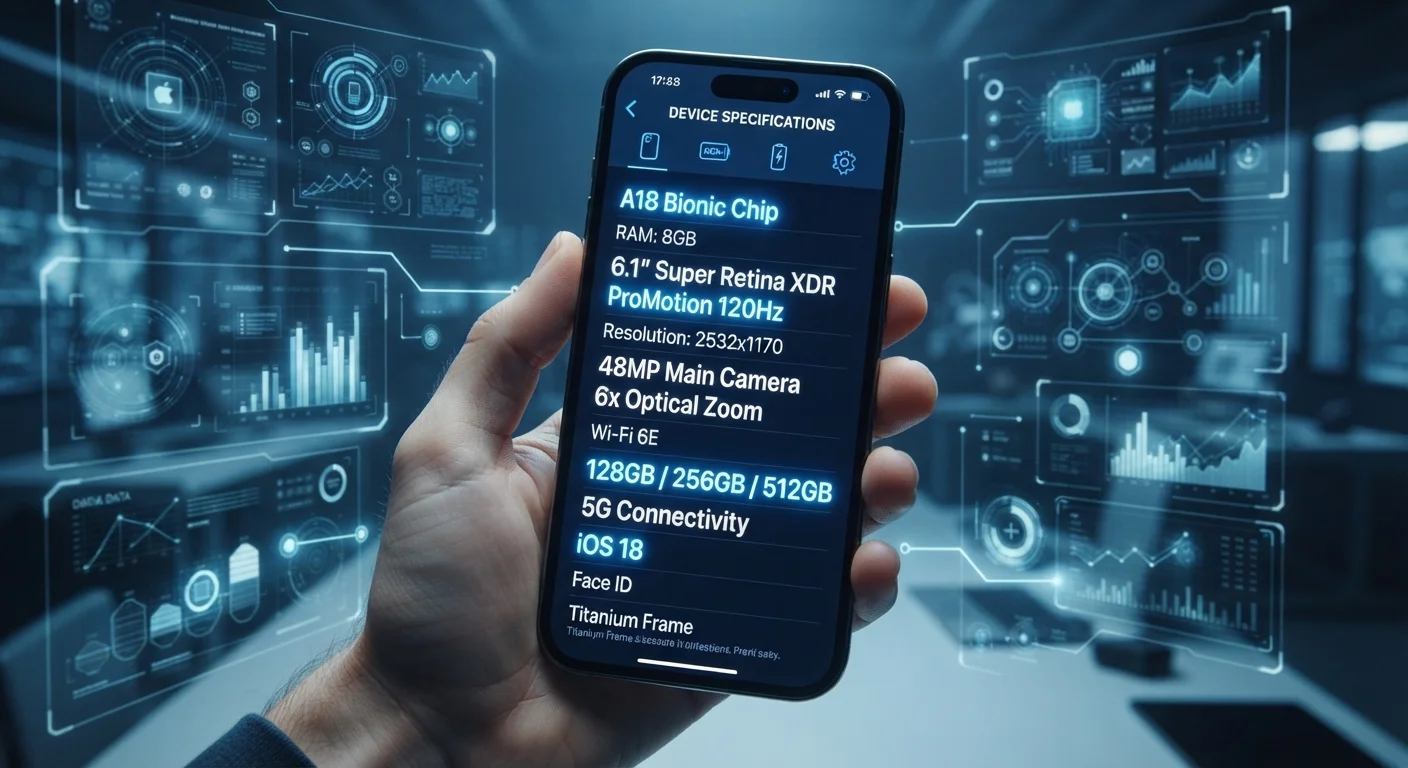
Key Takeaways
- The SoC (System on a Chip) is the single most impactful spec for overall speed and efficiency.
- RAM capacity matters, but OS memory management often matters more for day-to-day smoothness.
- Display refresh rate directly affects how fluid scrolling and animations feel to the eye.
- Megapixel count does not determine camera quality — sensor size and processing algorithms do.
- Battery capacity in mAh is only meaningful alongside the chip's power efficiency.
- Benchmark scores are useful for comparison but don't always predict real-world responsiveness.
Smartphone Specifications
Smartphone specifications are the standardized technical measurements manufacturers publish to describe a device's hardware capabilities — things like processor speed, memory, display resolution, and battery capacity. They allow consumers to compare phones on paper before buying. However, a specification number only describes a component's theoretical capability, not how well the phone actually performs in daily use.
Real-world performance depends on how hardware components interact with the device's operating system, thermal management, and software optimization — factors that rarely appear on a spec sheet.
The SoC: The Spec That Drives Everything Else
The System on a Chip (SoC) — sometimes called the chipset or processor — is the most consequential spec on any smartphone listing. It integrates the CPU (central processing unit), GPU (graphics processor), neural processing unit for AI tasks, and the cellular modem onto a single piece of silicon. Chip generation and architecture matter more than clock speed alone: a newer-generation chip running at a lower GHz can easily outperform an older design clocked higher.
For everyday tasks — launching apps, multitasking, processing photos — SoC efficiency determines how fast and how long the phone runs before needing a charge. A more efficient chip also produces less heat, which directly reduces thermal throttling, the process where a device automatically slows itself down to prevent damage. Benchmark scores don't always capture this nuance, which is why chip generation and real-world reviews matter more than raw numbers.
120Hz
Refresh rate that visibly improves scrolling smoothness
Display industry testing consistently shows that most users perceive a meaningful smoothness difference between 60Hz and 120Hz in everyday scrolling tasks.
UFS 4.0
Current fastest mainstream smartphone storage standard
UFS 4.0 offers roughly double the sequential read speeds of UFS 3.1, translating to faster app launches and file operations on compatible devices.
~15–20%
Typical performance reduction from thermal throttling
Independent hardware analysis suggests sustained workloads can reduce processor performance by 15–20% or more as devices manage heat, a factor absent from peak benchmark scores.
RAM and Storage: What the Numbers Don't Tell You
RAM (Random Access Memory) determines how many apps and processes a phone can hold in memory simultaneously. More RAM generally means fewer app reloads when you switch between tasks, but the operating system's memory management policy is equally important. Some platforms aggressively kill background apps even on high-RAM devices, while others keep more active with less. In practice, most users won't notice a tangible difference between 8GB and 12GB of RAM for standard daily use.
Internal storage capacity — typically listed in GB or TB — also comes with a hidden variable: storage speed, measured by the UFS (Universal Flash Storage) standard. A phone with UFS 3.1 reads and writes data significantly faster than one using UFS 2.2, affecting app install times, photo save speeds, and file transfers. Spec sheets often list the storage size prominently while burying or omitting the storage generation entirely. For a full breakdown of what spec sheets include and deliberately leave out, see our end-to-end spec sheet guide.
Check Storage Generation, Not Just Capacity
When comparing phones, look for UFS version numbers alongside storage capacity. A phone with 128GB of UFS 3.1 storage will load apps and transfer files noticeably faster than one with 256GB of UFS 2.2. Manufacturers don't always make this easy to find — check detailed spec pages or third-party reviews rather than the retail listing alone.
Display and Camera: Where Marketing Specs Mislead Most
Two areas where headline numbers routinely misrepresent real-world quality are displays and cameras.
For displays, refresh rate — measured in Hz — describes how many times per second the screen updates. At 60Hz, the display refreshes 60 times per second; at 120Hz, it doubles that, producing visibly smoother scrolling and animations. Resolution (measured in pixels) and peak brightness (measured in nits) also affect usability, particularly outdoors. However, panel technology — OLED versus LCD — often has a more pronounced impact on color accuracy and contrast than resolution alone. Our smartphone specs glossary explains each display term in plain language.
For cameras, megapixels measure resolution, not quality. A 200MP sensor on a small image sensor with poor low-light processing will take worse photos in most conditions than a 50MP sensor with a larger sensor area and strong computational photography. Key indicators of camera capability include sensor size, aperture (f-number), optical image stabilization (OIS), and the quality of the on-device image signal processor (ISP) — few of which appear prominently on marketing materials.
Battery Life: Capacity Is Only Half the Equation
Battery capacity is listed in milliampere-hours (mAh) — a measure of energy stored. A higher mAh figure does not automatically translate to longer battery life. A power-hungry processor in a large-battery phone can still drain faster than an efficient chip in a smaller-battery device. The SoC's power efficiency, display brightness and refresh rate, background connectivity (5G vs. Wi-Fi), and software optimization collectively determine how far a charge actually takes you.
Similarly, fast-charging wattage tells you how quickly a battery can refill, but sustained charging speed, thermal management during charging, and long-term battery health degradation rates are rarely disclosed. For a broader look at how hardware specs interact with real-world use, the Smartphone Specs Decoded guide offers additional context across all major spec categories.
“A spec sheet is a manufacturer's best argument for their product. The real question is always: best at what, and for whom? Context is everything when interpreting hardware numbers.”
— Anandal Shimpi, Founder of AnandTech, widely cited hardware analyst