

Key Takeaways
- Android offers greater hardware choice and deeper system-level customisation than iOS.
- iOS typically delivers longer, more predictable software update support per device.
- Privacy controls are robust on both platforms, but implemented differently by design.
- App quality and selection are comparable; exclusive titles and timing differences do exist.
- Ecosystem lock-in is a real switching cost — consider your existing devices before committing.
- No single platform is objectively superior; the right choice depends on your specific priorities.
Option A
Android
The open, flexible platform built for choice.
Best for: Users who want deep customisation, hardware variety, and fewer walled-garden restrictions.
Option B
iOS
The tightly integrated ecosystem optimised for consistency.
Best for: Users who prioritise seamless hardware-software integration, long software support, and Apple device continuity.
If you want extensive hardware options at multiple price points
Android
Android runs on hundreds of devices from dozens of manufacturers, giving consumers genuine choice across every budget tier.
If you already own multiple Apple devices
iOS
Features like Handoff, AirDrop, and iMessage create a seamless cross-device experience that is difficult to replicate outside the Apple ecosystem.
If long-term software update guarantees matter to you
iOS
Apple has a strong track record of supporting devices with major OS updates for six or more years, providing more predictable longevity.
If you prefer granular control over your device experience
Android
Android allows sideloading apps, setting third-party defaults, and extensive home screen customisation that iOS does not fully match.
If you are switching ecosystems and need to evaluate switching costs
Android
Android's more open standards generally make data portability and cross-platform app compatibility easier to navigate during a transition.
Customisation and Control
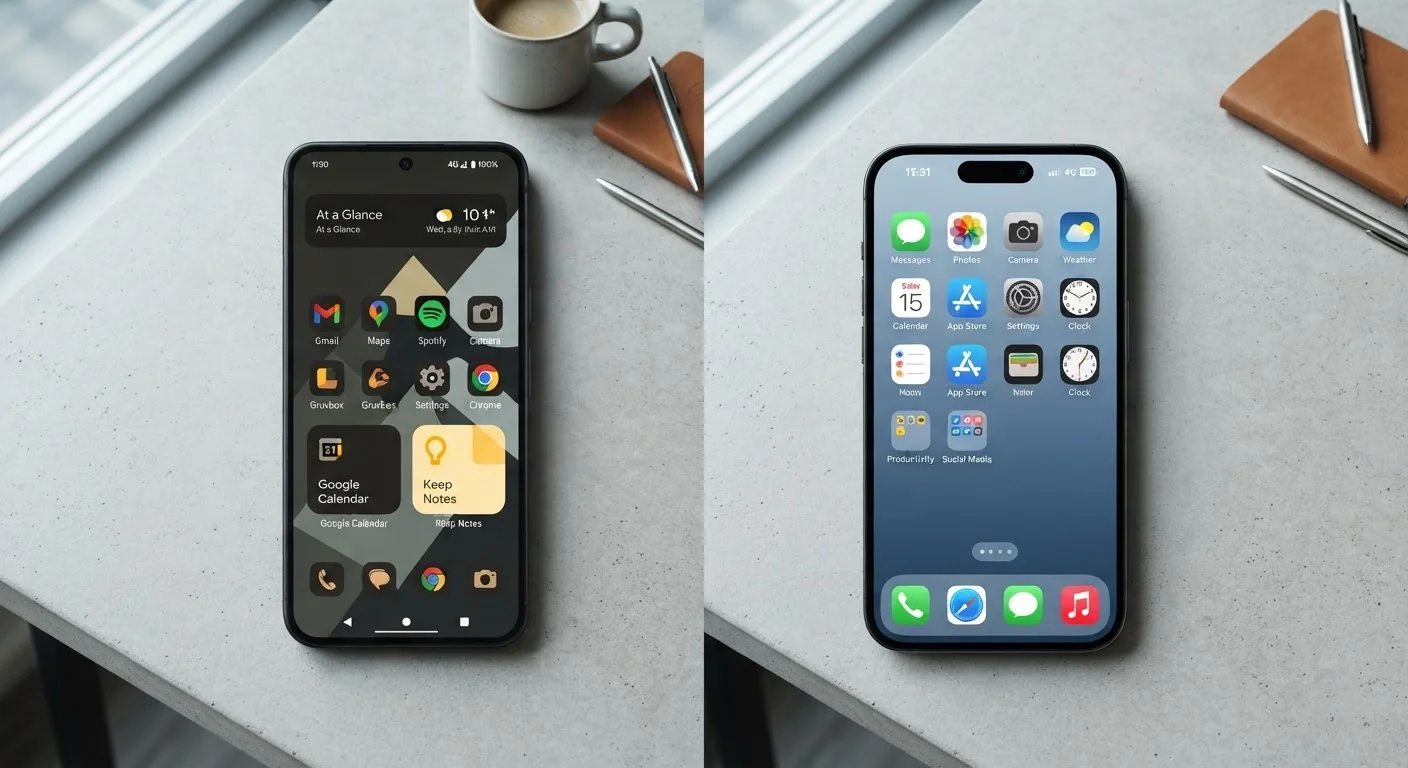
Android and iOS diverge most visibly in how much control they hand to the user. Android permits setting third-party apps as defaults for browsers, email, and camera functions, and supports home screen widgets, custom launchers, and — on most devices — sideloading apps that aren't distributed through the official Play Store. This openness comes with a tradeoff: the experience varies considerably depending on which manufacturer's version of Android you're using, since hardware makers layer their own software on top of the base operating system.
iOS takes a more curated approach. Apple controls both the hardware and the software, which produces a highly consistent experience across all supported iPhones. Customisation options have expanded over recent iOS versions — including home screen widgets and the ability to set some third-party app defaults — but the platform still enforces meaningful guardrails around what apps can do and how the system can be modified. For users who find unlimited choice overwhelming, that consistency is a feature, not a limitation. For those who want to tailor every aspect of their phone, it can feel restrictive.
Read our deeper look at the design philosophies behind each platform for more context on why these differences exist.
Privacy, Security, and Software Updates
Both platforms have made privacy a prominent engineering priority, but their implementations differ. iOS enforces strict app sandboxing and requires explicit user permission for location, camera, microphone, and contact access. Apple's App Tracking Transparency framework requires apps to request permission before tracking users across third-party sites and apps — a meaningful control not natively replicated on Android at the same system level, though Android has added privacy dashboard features and permission auto-reset in recent versions.
On the security update front, iOS has a structural advantage: Apple pushes updates directly to all supported devices simultaneously. Android's update pipeline is more fragmented. While Google's own Pixel devices receive timely updates, third-party manufacturers vary significantly in how quickly — and for how long — they deliver OS and security patches. Some Android manufacturers now commit to multi-year update schedules, but the landscape remains inconsistent compared to Apple's centralized model.
| Criterion | Android | iOS |
|---|---|---|
| Hardware variety | Hundreds of devices, many brands | iPhone lineup only |
| System customisation | Deep — launchers, defaults, sideloading | Moderate — expanding but still curated |
| Software update consistency | Varies by manufacturer | Centralized, simultaneous, multi-year |
| App tracking controls | Privacy dashboard, permission auto-reset | App Tracking Transparency (explicit consent) |
| Cross-device integration | Strong with Google services and Windows | Seamless within Apple device ecosystem |
| App store quality floor | Broad, variable review standards | Stricter review, slower approvals |
| Entry-level price range | Wide — budget to flagship | Mid to premium pricing |
If notification behaviour differences concern you after a switch, our side-by-side notification troubleshooting comparison covers how each platform handles alerts and how to resolve common issues.
App Ecosystems and Ecosystem Lock-In
The gap between the Google Play Store and Apple App Store has narrowed considerably. The vast majority of mainstream apps are available on both platforms. Differences tend to appear in niche categories, timing of new releases (some developers still launch iOS-first), and the quality floor — Apple's review process is generally considered more rigorous, though this also means slower app approvals.
The more consequential consideration is ecosystem lock-in. iOS users who also own a Mac, iPad, or Apple Watch benefit from continuity features — seamless handoffs between devices, shared clipboard, unified messaging — that represent genuine productivity value. Android integrates well with Google services (Drive, Photos, Gmail) and increasingly with ChromeOS and Windows via tools like Phone Link. But neither ecosystem makes switching painless once you've built workflows around it.
~72%
Global smartphone OS market share (Android)
Statcounter's global mobile OS data consistently shows Android holding the majority of worldwide smartphone market share, driven by hardware diversity and emerging market presence.
6+ years
iOS software support per device (typical)
Apple has supported several iPhone models with major OS updates for six or more years, a benchmark that most Android manufacturers have not yet consistently matched.
Before committing to a platform, audit which services and devices you already use. Our guide to smartphone basics explores how to think through these decisions systematically, and our article on avoiding spec-sheet thinking in cross-brand comparisons can help you evaluate hardware options within whichever ecosystem you choose.