

Key Takeaways
- Scammers exploit the trust of your social network by hijacking or impersonating real friend accounts.
- Fake giveaways, fraudulent ads, and romance scams are among the most common social media fraud types.
- Urgency and emotional pressure are deliberate tactics designed to bypass your better judgment.
- Verifying requests through a separate channel — like a phone call — can stop many scams cold.
- Locking down your privacy settings limits how much scammers can learn about you before targeting you.
Why Social Platforms Are a Scammer's Favorite Hunting Ground
Social media connects you to people you know and trust — and that's precisely what makes it so useful to fraudsters. Unlike cold-call or email phishing, social media scams often arrive wrapped in the credibility of a familiar face. A message appears to come from an old friend, a family member, or a brand you follow, and your guard drops instinctively.
The scale of the problem is significant. The U.S. Federal Trade Commission has consistently reported that social media is among the top channels through which consumers lose money to fraud, with losses running into the hundreds of millions of dollars annually. Understanding how these scams are engineered — and what they look like in practice — is the most effective first line of defense. For a broader grounding in online fraud, see our consumer's complete starting point.
Friend Account Takeovers
One of the most disarming social media scams involves a message from someone already in your contacts — except it isn't really them. Scammers gain access to a friend's account through credential theft or phishing, then message their contacts posing as the account owner. Common scripts include requests for emergency cash, gift card codes, or login help.
If a friend sends you an unusual message asking for money or sensitive information, contact them directly through a different channel — a phone call works best — before responding. A compromised account will often show subtle signs: a change in writing style, an uncharacteristic sense of urgency, or links to unfamiliar sites.
When a friend's message feels off, verify through a phone call before you respond.
Fake Giveaways and Prize Scams
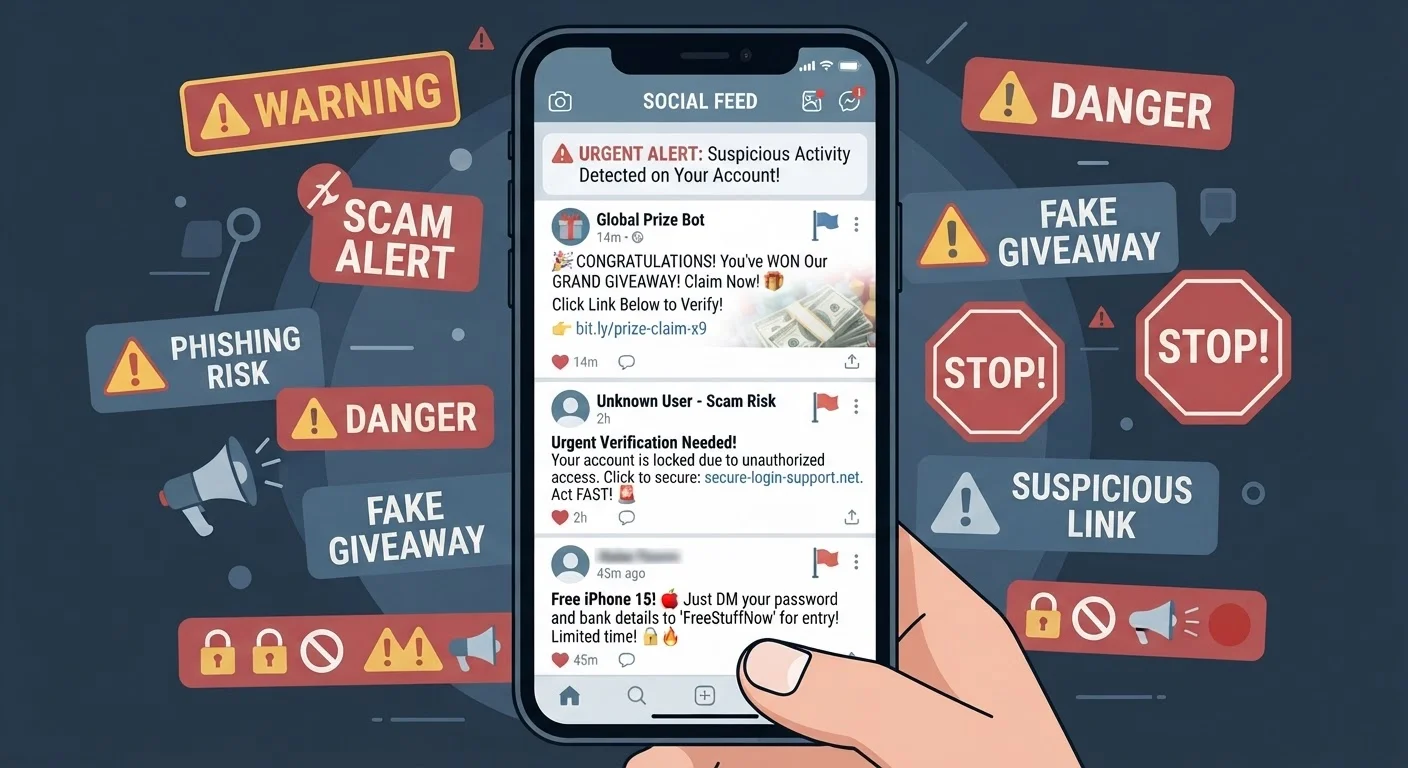
Posts promising free electronics, cash, or gift cards in exchange for a like, share, or comment are widespread on every major platform. Some mimic the look of real brand accounts with convincing logos and follower counts inflated by bots. The goal is to harvest personal data, drive traffic to malicious sites, or extract a small "processing fee" from hopeful participants.
Legitimate giveaways from established organizations are typically promoted through verified accounts (look for platform verification badges) and never require payment or sensitive personal details to enter. If a prize seems disproportionately large for the effort required, treat it as a red flag.
No legitimate giveaway ever requires a payment or sensitive personal details to claim a prize.
Fraudulent Paid Advertisements
Scammers can and do purchase ad placements on social platforms, allowing them to reach users they have no connection with whatsoever. These ads often impersonate well-known retailers, charities, or financial services, directing clicks to convincing but fraudulent websites designed to steal payment information or login credentials. Our article on why scammers impersonate trusted brands explains why these look-alike tactics are so effective.
Before clicking an ad, look at the URL it points to. Fraudulent sites frequently use domain names that are a single character off from the real one. When in doubt, navigate directly to the brand's official website by typing the address yourself.
Type a brand's web address directly rather than trusting a social media ad link.
Romance and Relationship Scams
Romance scams begin with a connection request or direct message from someone presenting themselves as an attractive, successful individual. Over days or weeks, the scammer builds emotional rapport before introducing a financial need — a medical emergency, a stranded travel situation, or a business opportunity that requires an investment. Victims are often targeted based on publicly visible profile information, including relationship status, age, or recent life events.
Be cautious of anyone who professes strong feelings quickly, refuses to meet in person or via live video, and eventually steers conversations toward money. These are consistent markers of a manufactured relationship intended to exploit trust.
Rapid emotional escalation online, followed by a financial request, is a classic fraud pattern.
Quizzes and Surveys That Harvest Personal Data
"Which city should you actually live in?" and "What does your birth month say about your personality?" may look harmless, but many third-party quizzes and surveys circulating on social platforms are designed to extract answers to common security questions — your mother's maiden name, your first pet, your childhood street — which can then be used to bypass account security elsewhere.
Think carefully before participating in any quiz that asks questions mirroring typical password recovery prompts. Adjust your social media privacy settings so that only trusted contacts can see your profile details, reducing how much background information is available to would-be scammers. Your smartphone's privacy settings also play a role in controlling what data apps can access.
Innocent-looking quizzes can harvest answers to your security questions without you realizing it.
Fake Customer Support Accounts
When users post complaints or questions directed at a company's social media page, scammers monitoring those platforms sometimes swoop in with a reply from a fake support account. These impostor accounts mimic the branding of the real company and offer to "resolve the issue" — often by asking for account credentials or directing the user to a phishing site.
Always verify that a support account responding to you is the platform's official, verified account. Reach out to customer service proactively through contact details listed on the company's official website, rather than relying on an account that initiated contact with you first.
If a support account contacts you first, verify it independently through the company's official website.
Staying Safer on Social Media
Awareness is a powerful tool, but it works best when paired with consistent habits. Before acting on any message or post — especially one that involves money, personal information, or a link — pause and ask: does this request make sense coming from this person or organization? Could this account have been compromised?
Strengthen Your Social Media Privacy Now
Review the privacy settings on each platform you use and restrict who can see your posts, friend list, and personal details. Limit connection requests to people you know in real life. Enabling two-factor authentication on your social accounts also makes it significantly harder for scammers to take them over.
If a situation does go wrong, don't wait. Our guide on what to do after you've been phished walks through the steps to limit damage quickly. For a deeper look at the psychological techniques scammers use to override careful thinking, the scammer's playbook is worth reading alongside this article. Building durable protective habits will serve you well across every platform you use.