

Key Takeaways
- Length is the most important factor in resisting brute-force attacks — passphrases win here.
- A passphrase made of four or more random words can be significantly harder to crack than a short complex password.
- Traditional passwords are often weakened by predictable substitutions users make to meet complexity rules.
- Passphrases are generally easier to remember, which reduces the temptation to reuse credentials.
- Neither approach replaces other good habits like using a password manager and enabling two-factor authentication.
Option A
Traditional Password
The complex, character-dense classic.
Best for: Situations requiring strict character-set rules imposed by legacy systems or specific platform requirements.
Option B
Passphrase
The longer, more memorable modern alternative.
Best for: Everyday account logins where memorability and strong entropy both matter.
If you want the most memorable credential that's still highly secure
Passphrase
A string of four or more random words is long enough to provide strong entropy while remaining easy to recall without writing it down.
If a site enforces strict character-set rules and limits credential length
Traditional Password
Some legacy platforms cap input length or require specific symbols, making a structured complex password the only viable option.
If you rely on a password manager to store all credentials
Traditional Password
When memory is taken out of the equation, a randomly generated high-complexity password provides robust protection for stored accounts.
If you need a single credential you must actually memorize
Passphrase
Passphrases reduce the cognitive load that leads to insecure shortcuts like reusing or slightly modifying an existing password.
How Each Approach Works
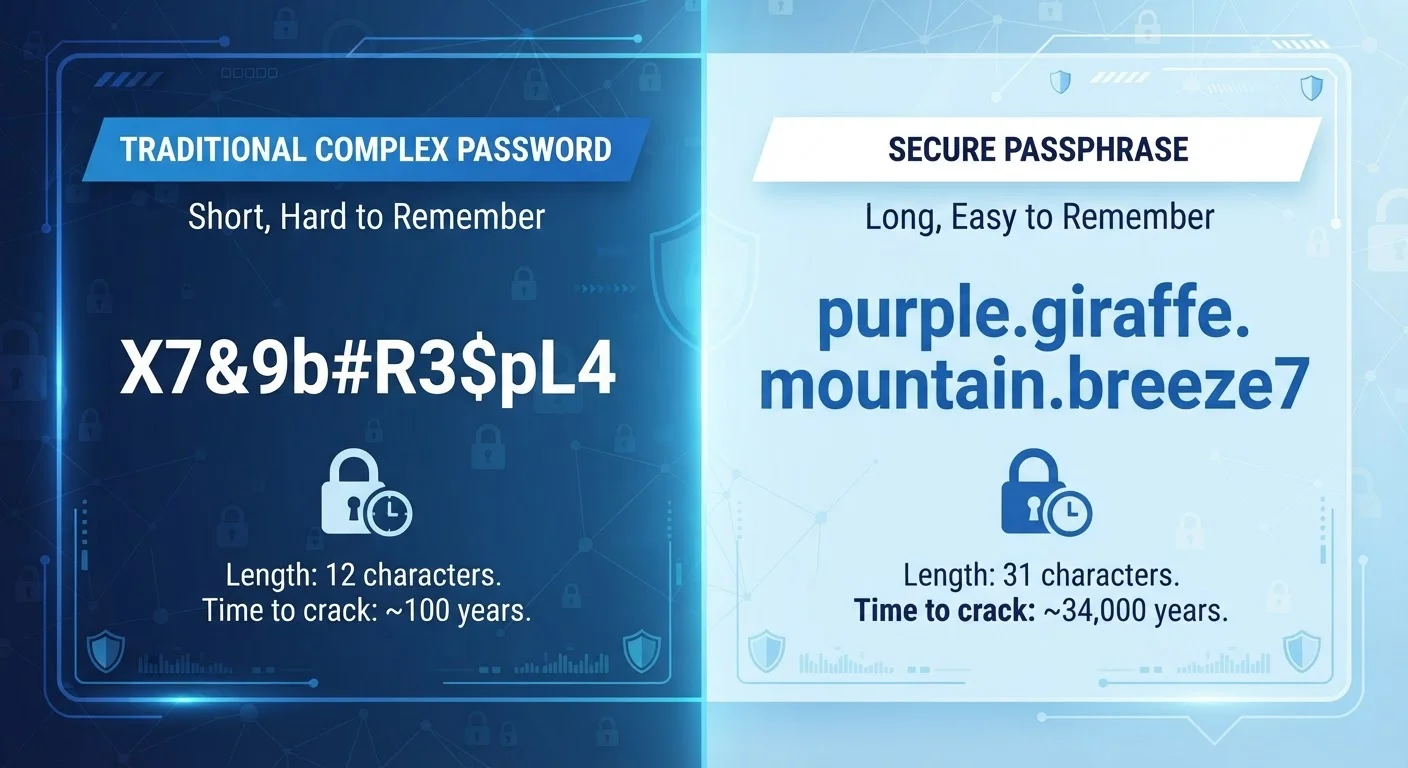
A traditional password typically combines uppercase and lowercase letters, numbers, and symbols into a short string — something like T7#mZ!q2. Complexity rules enforced by many platforms push users in this direction. The underlying logic is that mixing character types expands the pool of possible combinations an attacker must try.
A passphrase takes the opposite approach: instead of cramming variety into a short string, it builds length from a sequence of ordinary words — for example, marble-cloud-river-stamp. The security comes not from complexity but from sheer length and randomness. As explained in our plain-language password glossary, this property is measured as entropy — the mathematical unpredictability of a credential.
Both methods aim to produce a credential that attackers cannot easily guess or compute. The key question is which one does that job better under real-world conditions.
The Math: Why Length Beats Complexity
Modern brute-force attacks work by testing enormous numbers of candidate credentials per second using specialized hardware. The time required grows exponentially with credential length, which gives long passphrases a significant structural advantage.
51+ bits
Entropy from 4 random Diceware words
The Electronic Frontier Foundation's Diceware word list assigns approximately 12.9 bits of entropy per word when chosen randomly.
~6.6 quadrillion
Combinations in an 8-character complex password
Using a 95-character set, an 8-character password produces roughly 6.6 quadrillion possible strings — a space modern hardware can search in hours.
86%
Breached passwords that were common patterns
Analysis of large breach datasets consistently finds the majority of cracked passwords follow predictable substitution or appending patterns.
A traditional 8-character password using the full printable character set (~95 characters) produces roughly 958 possible combinations — about 6.6 quadrillion. That sounds large, but dedicated cracking hardware can exhaust that space in hours or days. By contrast, a passphrase drawn randomly from a list of 7,776 common words (a method known as Diceware) gives each word roughly 12.9 bits of entropy. Four such words yields over 51 bits of entropy — and five words pushes past 64 bits, making exhaustive search computationally impractical with current technology.
The crucial caveat: the words must be chosen randomly, not by a human picking favorites. Our article on what actually makes a password strong explores why human-selected patterns dramatically reduce real-world entropy.
| Criterion | Traditional Password | Passphrase |
|---|---|---|
| Primary strength source | Character-set variety | Length and word count |
| Typical length | 8–12 characters | 20–40 characters |
| Entropy (4 random words vs 8 mixed chars) | ~52 bits | ~51+ bits (scales with words) |
| Memorability | Difficult — drives reuse | Easier — reduces reuse risk |
| Vulnerability to pattern attacks | High if human-generated | Low if randomly selected |
| Platform compatibility | Near-universal | Limited by some length caps |
Where Traditional Passwords Fall Short
Complexity requirements were designed with good intentions but have a well-documented side effect: they produce predictable behavior. When told to add a symbol, most people append an exclamation mark. When forced to include a number, many choose 1 at the end. Attackers' dictionaries are built around exactly these patterns.
As our guide on how attackers actually steal passwords details, credential-stuffing and dictionary attacks exploit the gap between apparent complexity and true randomness. A password that looks strong to a human eye may sit near the top of an attacker's probability-weighted guess list.
Short passwords are also disproportionately vulnerable once a database is breached and password hashes are exposed. Offline cracking against stolen hashes removes rate-limiting protections and allows billions of guesses per second.
Where Passphrases Have Limits
Passphrases are not a perfect solution in every context. Some platforms impose maximum character limits that prevent entering a phrase long enough to be meaningful — a frustrating and counterproductive constraint. Others reject spaces, which are often needed to separate passphrase words naturally.
There is also a memorability trap. If a user constructs a passphrase from personally meaningful words — pet names, birthdays, favorite places — rather than truly random selections, the entropy advantage largely disappears. Attackers who know basic facts about a target can narrow their search considerably. True randomness, achieved by dice rolls or a reputable generator tool, is essential.
Finally, relying on memory alone creates risk even for passphrases. Reusing the same passphrase across multiple accounts transfers the vulnerability of any single breach to every account it protects. See our walkthrough on creating unique credentials for every account for practical strategies.
Two-Factor Authentication Strengthens Either Approach
Whether you use a passphrase or a complex password, enabling two-factor authentication (2FA) adds a separate layer of protection that credential attacks alone cannot bypass. Even if your password is compromised in a breach, 2FA requires attackers to also control a second factor — such as a one-time code sent to your device. Treat 2FA as a complement to a strong credential, not a substitute for one.