

| First consumer Wi-Fi standard | 802.11b (1999) (IEEE 802.11 Working Group) |
| Current latest standard | Wi-Fi 7 (802.11be) (Wi-Fi Alliance, 2024) |
| Most widely deployed standard | Wi-Fi 5 (802.11ac) (Wi-Fi Alliance industry data) |
| Frequency bands used by Wi-Fi 7 | 2.4 GHz, 5 GHz, and 6 GHz (IEEE 802.11be specification) |
| Max channel width (Wi-Fi 7) | 320 MHz (IEEE 802.11be specification) |
| Security standard tied to Wi-Fi 6 certification | WPA3 (required) (Wi-Fi Alliance certification requirements) |
Understanding the Naming System
Wi-Fi standards were historically named with IEEE (Institute of Electrical and Electronics Engineers) designations like 802.11a or 802.11ac. In 2018, the Wi-Fi Alliance introduced a simplified numbering system — Wi-Fi 4, Wi-Fi 5, Wi-Fi 6 — to make it easier for consumers to identify what generation of wireless technology a device supports. Both naming systems remain in use, so knowing how they map to each other matters when reading a spec sheet.
For a broader look at how wireless signals work before diving into standards, see our plain-language explainer on how Wi-Fi works.
| First consumer Wi-Fi standard | 802.11b (1999) (IEEE 802.11 Working Group) |
| Current latest standard | Wi-Fi 7 (802.11be) (Wi-Fi Alliance, 2024) |
| Most widely deployed standard | Wi-Fi 5 (802.11ac) (Wi-Fi Alliance industry data) |
| Frequency bands used by Wi-Fi 7 | 2.4 GHz, 5 GHz, and 6 GHz (IEEE 802.11be specification) |
| Max channel width (Wi-Fi 7) | 320 MHz (IEEE 802.11be specification) |
| Security standard tied to Wi-Fi 6 certification | WPA3 (required) (Wi-Fi Alliance certification requirements) |
Every Major Wi-Fi Standard at a Glance
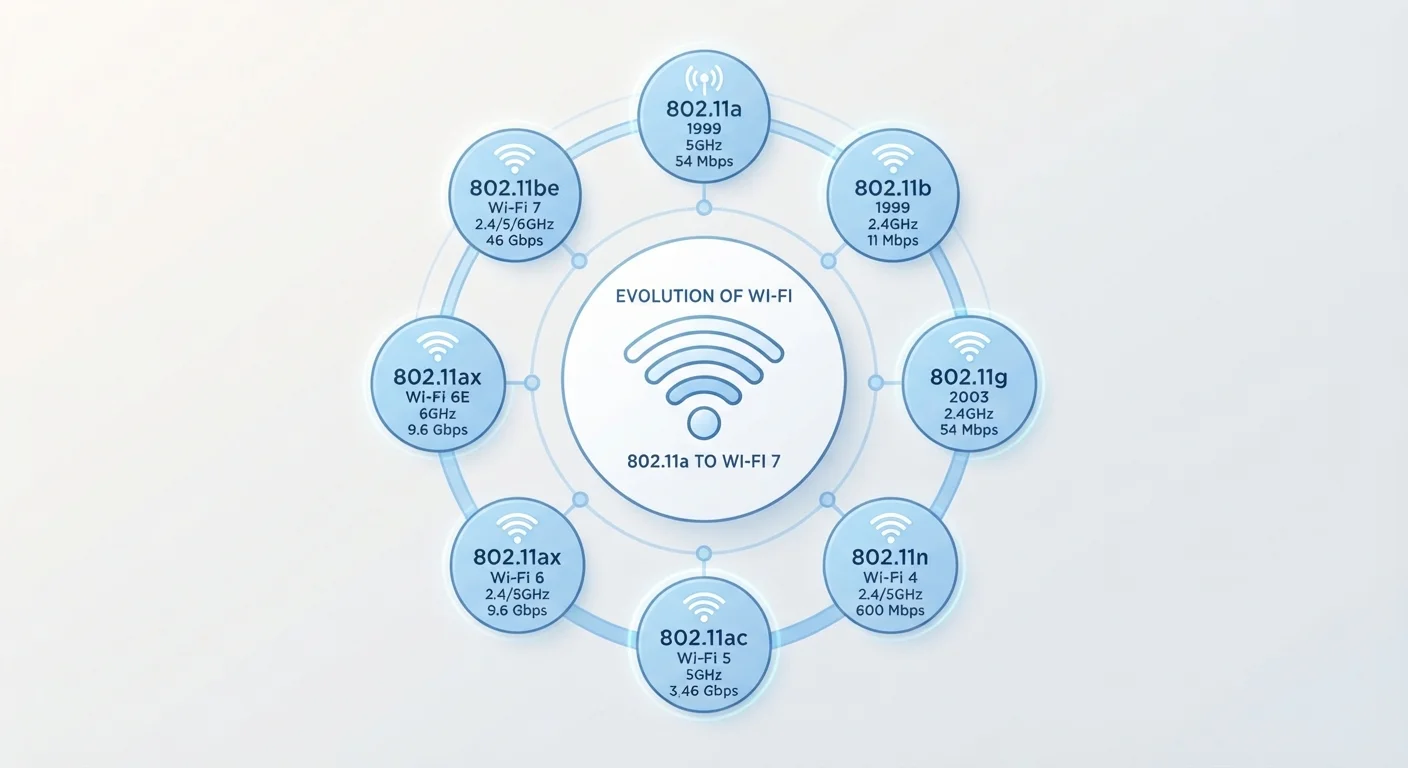
The table below maps each IEEE designation to its Wi-Fi generation name, the frequency bands it uses, and its theoretical maximum throughput. Real-world speeds are always lower than theoretical maximums due to interference, distance, and the number of connected devices.
| IEEE Name | Wi-Fi Generation | Year Introduced | Frequency Band(s) | Max Theoretical Speed |
|---|---|---|---|---|
| 802.11a | — | 1999 | 5 GHz | 54 Mbps |
| 802.11b | — | 1999 | 2.4 GHz | 11 Mbps |
| 802.11g | — | 2003 | 2.4 GHz | 54 Mbps |
| 802.11n | Wi-Fi 4 | 2009 | 2.4 GHz & 5 GHz | 600 Mbps |
| 802.11ac | Wi-Fi 5 | 2013 | 5 GHz | 3.5 Gbps |
| 802.11ax | Wi-Fi 6 / Wi-Fi 6E | 2019 / 2021 | 2.4, 5, & 6 GHz | 9.6 Gbps |
| 802.11be | Wi-Fi 7 | 2024 | 2.4, 5, & 6 GHz | 46 Gbps |
Wi-Fi 6E is a variant of Wi-Fi 6 (802.11ax) that adds access to the 6 GHz band, which was newly opened for unlicensed use in the US. It carries the same underlying protocol but provides significantly more spectrum in less congested territory. For a deeper look at how the three frequency bands compare in range and throughput, see our guide on choosing between 2.4 GHz, 5 GHz, and 6 GHz.
46 Gbps
Wi-Fi 7 theoretical maximum throughput
Per the IEEE 802.11be specification; real-world speeds depend on environment, device count, and signal quality.
~75×
Speed increase from 802.11b to Wi-Fi 7
Comparing 802.11b's 11 Mbps theoretical maximum to Wi-Fi 7's 46 Gbps peak, illustrating 25 years of standard evolution.
3
Frequency bands supported by Wi-Fi 6E and Wi-Fi 7
The addition of 6 GHz band access, opened for unlicensed use in the US starting in 2020, significantly expands available spectrum.
Key Technical Advances by Generation
802.11a/b/g established the foundation of consumer Wi-Fi. The 2.4 GHz band offered better range; the 5 GHz band offered more speed but shorter reach. These standards are now obsolete on modern hardware.
Wi-Fi 4 (802.11n) introduced MIMO — the use of multiple antennas to send and receive several data streams simultaneously — dramatically improving reliability and speed over earlier standards.
Wi-Fi 5 (802.11ac) added MU-MIMO (Multi-User MIMO), allowing a router to communicate with several devices at the same time rather than cycling through them sequentially. It also introduced wider 80 MHz and 160 MHz channel widths.
Wi-Fi 6 / 6E (802.11ax) prioritized efficiency alongside speed. It introduced OFDMA, a technique that lets a single transmission carry data to multiple devices at once — reducing latency and improving performance in crowded environments like apartments or offices.
Wi-Fi 7 (802.11be) adds Multi-Link Operation (MLO), which allows devices to simultaneously use multiple frequency bands and channels. It also doubles the maximum channel width to 320 MHz and supports 4K-QAM modulation for denser data encoding. If you are weighing whether these advances justify an upgrade, our article on the trade-offs of upgrading to Wi-Fi 6 or Wi-Fi 7 covers the practical considerations.
MIMO
Multiple Input Multiple Output. A technology using multiple antennas on both the router and device to send and receive several data streams at once, improving throughput and reliability.
MU-MIMO
Multi-User MIMO. An extension of MIMO that allows a router to communicate with multiple devices simultaneously rather than taking turns, reducing wait times on busy networks.
OFDMA
Orthogonal Frequency Division Multiple Access. Introduced in Wi-Fi 6, this technique subdivides a channel into smaller resource units, allowing a router to serve multiple devices within a single transmission and cutting latency.
Channel Width
The amount of radio frequency spectrum a Wi-Fi connection uses for a single transmission, measured in MHz. Wider channels (80 MHz, 160 MHz, 320 MHz) can carry more data but are more susceptible to interference.
MLO
Multi-Link Operation. A Wi-Fi 7 feature that lets a device connect across multiple frequency bands and channels simultaneously, improving both speed and reliability.
QAM
Quadrature Amplitude Modulation. A method of encoding more data into each radio signal. Higher QAM values (e.g., 4096-QAM in Wi-Fi 7) pack more bits per transmission but require a strong, clean signal to work reliably.
Frequency Band
A range of radio frequencies used for wireless communication. Wi-Fi commonly uses 2.4 GHz, 5 GHz, and (in newer standards) 6 GHz bands, each with different trade-offs in speed and range.
What This Means When Buying Devices
A device's Wi-Fi generation sets its ceiling, not its guarantee. A Wi-Fi 6 phone on a Wi-Fi 5 router will negotiate down to Wi-Fi 5 — wireless connections always operate at the capability of the less advanced device. Both the router and the client device must support the same standard to unlock its full feature set.
Older standards (Wi-Fi 4 and 5) remain common and deliver more than adequate performance for typical home internet connections. The gains from Wi-Fi 6 and Wi-Fi 7 are most noticeable in high-density environments, multi-device households, or use cases involving very low latency such as cloud gaming or video calls. For more context on what each generation actually delivers in practice, see what Wi-Fi standards mean for your devices.
Wi-Fi standards also interact with security protocols. For example, WPA3 — the current recommended security standard — is a required feature of Wi-Fi 6 certification. For more on this, see our comparison of WPA2 and WPA3. Unfamiliar with related acronyms like SSID or DHCP? Our Wi-Fi terms reference defines the most common ones in plain language.
Backward Compatibility Is Built In
Wi-Fi standards are designed to be backward compatible. A Wi-Fi 6 router can connect to Wi-Fi 4 and Wi-Fi 5 devices without issue — both sides simply negotiate to the highest standard they share. This means upgrading your router does not require replacing every device at once, though older devices won't benefit from the newer standard's advanced features.