

Key Takeaways
- Mobile data is encrypted at the cellular layer, making it more secure than unprotected public Wi-Fi by default.
- A VPN encrypts traffic end-to-point to the VPN server, shielding it from your carrier but shifting trust to the VPN provider.
- For most sensitive tasks on cellular, HTTPS websites and apps with end-to-end encryption already offer strong protection.
- VPNs provide the most meaningful benefit on public Wi-Fi, not on mobile data connections.
- The right choice depends on your specific threat model — what you're doing and who you're concerned about.
Option A
Mobile Data (Cellular Network)
The built-in, carrier-managed connection most smartphones rely on.
Best for: Everyday browsing, app use, and tasks where carrier-level encryption provides adequate baseline security.
Option B
VPN (Virtual Private Network)
An encrypted tunnel layered on top of any network connection.
Best for: Adding a privacy layer when connecting over untrusted networks or when concealing traffic from your carrier or ISP.
If you're banking or shopping exclusively on cellular data
Mobile Data (Cellular Network)
Carrier encryption combined with HTTPS provides a robust security baseline for financial tasks on cellular. Adding a VPN introduces a third-party trust relationship without significantly improving security in this scenario.
If you're using public Wi-Fi for any sensitive task
VPN (Virtual Private Network)
Public Wi-Fi lacks the carrier-level encryption that mobile data provides. A reputable VPN meaningfully reduces exposure on open networks by encrypting your traffic before it leaves your device.
If you're concerned about your carrier monitoring your browsing habits
VPN (Virtual Private Network)
A VPN prevents your mobile carrier from seeing which sites and services you access, though it moves that visibility to your VPN provider instead.
If speed and battery life are priorities during routine tasks
Mobile Data (Cellular Network)
VPNs introduce routing overhead that can reduce connection speeds and increase battery consumption, making bare cellular connections preferable for tasks where security requirements are low.
How Each Connection Actually Protects Your Data
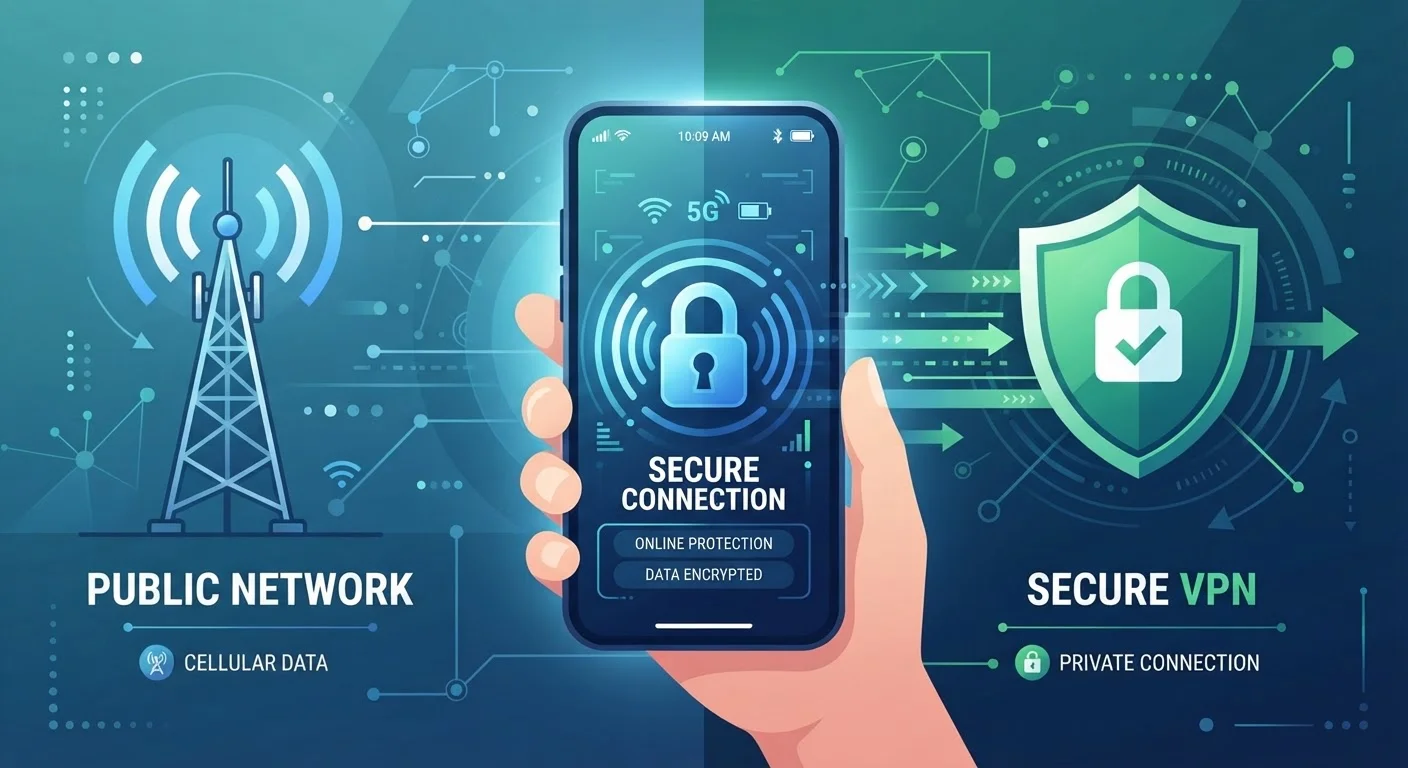
When you connect via mobile data, your device communicates with your carrier's infrastructure over an encrypted radio channel. Modern cellular standards — 4G LTE and 5G — include encryption between your handset and the cell tower as a built-in feature of the protocol. This means casual eavesdropping on the radio link is substantially harder than intercepting unprotected Wi-Fi traffic. However, your carrier can still see metadata about your connections: which domains you visit, when, and how often.
A VPN (Virtual Private Network) creates an encrypted tunnel from your device to a server operated by the VPN provider. All traffic is routed through that server before reaching the open internet. This means your carrier sees only encrypted data flowing to a VPN endpoint — the actual sites and services you use become invisible to them. The trade-off is that the VPN provider now occupies the position your carrier previously held. Trust shifts, not disappears.
It's also worth noting that the majority of web traffic today travels over HTTPS, which encrypts content between your device and the destination website regardless of what network you're on. That layer of protection exists on top of both mobile data and VPN connections alike. See our guide to public Wi-Fi risks for a deeper look at where network-layer threats actually emerge.
| Criterion | Mobile Data | VPN |
|---|---|---|
| Radio-layer encryption | Yes, built into 4G/5G standards | No (adds tunnel encryption instead) |
| Traffic visible to carrier | Yes — metadata and destinations | No — carrier sees only VPN endpoint |
| Third-party trust required | Your mobile carrier | Your VPN provider |
| Protection on public Wi-Fi | Not applicable (cellular bypass) | Yes — encrypts traffic on open networks |
| Impact on speed and battery | Minimal overhead | Noticeable latency and battery cost |
| HTTPS compatibility | Works alongside HTTPS | Works alongside HTTPS |
| Anonymity provided | None — carrier knows your identity | Partial — VPN provider can log activity |
Where Each Approach Has Real Limitations
Mobile data isn't without vulnerabilities. Certain attack techniques — such as using rogue base stations sometimes called "IMSI catchers" — can potentially intercept cellular communications, though this requires specialized equipment and proximity to the target, placing it firmly outside the threat model of most everyday users. More practically, your carrier retains visibility into your traffic metadata and may share it with third parties under certain legal or commercial arrangements.
VPNs carry their own meaningful limitations. A VPN does not make you anonymous — your VPN provider can log your activity, and a subpoena or data breach at that provider exposes whatever records exist. Consumer VPN services vary widely in their logging policies, jurisdiction, and security practices, none of which are directly verifiable by the end user. Performance is also a consideration: routing traffic through an additional server adds latency, and running a VPN continuously can noticeably affect battery life on mobile devices. For a balanced look at these trade-offs in a different context, our article on VPN trade-offs on home networks covers similar principles.
Not All VPN Providers Are Equal
Consumer VPN services differ significantly in their data retention policies, the legal jurisdictions they operate under, and whether they have undergone independent security audits. A VPN that logs your activity offers substantially less privacy protection than its marketing may suggest. When evaluating a VPN for sensitive use, independently researched privacy policies and audit reports are more informative than headline claims.
Another often-overlooked factor is DNS. Even when using a VPN, DNS queries can sometimes leak outside the encrypted tunnel depending on how the VPN client is configured — potentially revealing your browsing activity to your ISP. Understanding DNS over HTTPS and its privacy implications can help you close that gap.
Practical Guidance: Matching the Tool to the Task
For most sensitive tasks performed on a cellular connection — logging into a bank, filing taxes through an app, or sending confidential work email — the combination of carrier encryption and HTTPS provides a solid baseline that is adequate for everyday use. Adding a VPN in this scenario does not eliminate risk; it redistributes who holds visibility over your traffic.
The calculus changes on public Wi-Fi. Open networks at airports, cafes, and hotels lack the radio-layer encryption that cellular provides, making a reputable VPN a genuinely useful tool in those environments. If you regularly switch between cellular and Wi-Fi throughout your day, a VPN with an automatic "kill switch" feature — which blocks traffic if the VPN drops unexpectedly — offers more consistent protection.
Beyond network choice, building broader safe browsing habits reduces risk across all connection types. Our guide to safe browsing habits outlines practical steps that complement whatever network you're on. Similarly, thinking about how your data is stored and backed up rounds out a holistic approach to mobile security — see our comparison of cloud vs. local backup options for context.
~95%
Web traffic encrypted via HTTPS
Google's Transparency Report has consistently shown that the vast majority of pages loaded in Chrome are served over HTTPS, meaning content encryption exists regardless of network type.
3–5×
Latency increase possible with VPN
Routing overhead through a VPN server can multiply round-trip latency, particularly when the server is geographically distant from the user.
The bottom line: neither mobile data nor a VPN is universally superior. Mobile data offers reliable built-in encryption that handles most everyday scenarios competently. A VPN adds a meaningful privacy layer in specific situations — particularly on untrusted networks — but introduces its own trust and performance considerations. Match the tool to the actual risk, not a perceived one.